
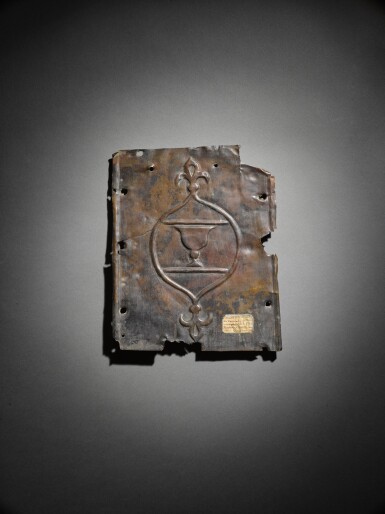
A fragment of a door panel with cup-bearer blazon, Syria, Mamluk, 15th century, or later
Estimate
10,000 - 15,000 GBP
Lot Details
Description
decorated in relief with a cup-bearer blazon flanked above and below by trefoils, old collection label to lower right
29.9 by 23.9cm.
Ex-private collection, France
inscriptions
Label: Fragment de la mosquée des Oméyyades, où était conservée la tête de Saint Jean Baptiste, à Dammas, incendiée et restaurée au XIème siècle.
‘Fragment of the Umayyad Mosque, where was kept the head of the saint Jean Baptiste, in Damascus, which was burnt down and rebuilt in the 11th century.’
The construction of the Umayyad Mosque, or the Great Mosque of Damascus, was completed in 715 AD, becoming the first monumental architectural work in Islamic history. Over centuries, the mosque has undergone series of restorations and renovations, though Flood attributes the Mamluks with an almost “obsessive interest” in the Umayyad Mosque and the Dome of the Rock, manifesting in extensive series of restorations (Flood 1997, p.72). Photographs published by L.E.M. Mols show decorative repoussé bronze door plaques dating to a renovation from 1417 under Sultan al-Mu'ayyad Shaykh, (r.1412-21), and that of Altunbugha al-'Uthmani, governor of Damascus in 1415. The decoration consists of various panels with calligraphy, rosettes and cup-bearer blazons (Mols 2006, pls.115-130). One such panel displays the word Allah enclosed within an elongated roundel with trefoil terminals, almost identical to the arrangement here (ibid., pl.125, no.31).
The label to the lower right indicates that this panel entered a French collection. The Umayyad Mosque has been restored at multiple points since the fifteenth century. In its more recent history, it suffered a fire in 1893 and required significant restoration that was completed in 1901 under the Ottomans. Other periods of restoration to the doors mentioned above are recorded in 1948 and 1957 (ibid.). From this time, commentators from the nineteenth century onwards developed a specific interest in the Mamluk era and came to regard it as the golden age in Egyptian history. Parallel to the construction of Mamluk-revival buildings, European residents in Egypt, whose number had rapidly increased in the second half of the nineteenth century, began to adorn their homes with works salvaged from the renovations and demolition of old buildings (Vernoit 1997, pp.229-230). In the most opulent iterations of this phenomenon, leading collectors such as Charles Gillot collected spectacular fourteenth century panels and commissioned leading Parisian woodworkers to form them into new structures (see Christie’s, Ancienne Collection Charles Gillot (1853-1903), 5 March 2008, lot 41. The entry of this panel into a French collection most likely formed part of this tradition.
You May Also Like


