
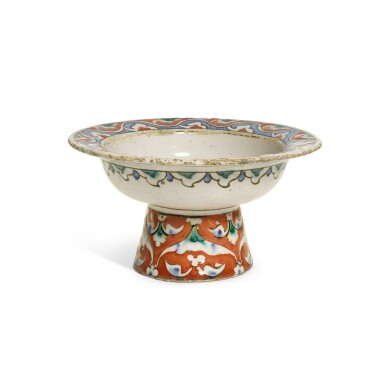
A rare Iznik polychrome pottery tazza, Turkey, circa 1580
Estimate
25,000 - 35,000 GBP
Lot Details
Description
of deep rounded form with slightly everted rim, on tall everted foot, painted in underglaze bole-red, cobalt-blue, and green, outlined in black, the interior with a central arabesque roundel, the rim with red and blue waved bands enclosing half-palmettes, the foot decorated with arabesques, exhibition label to foot
18.6cm. diam.
9.6cm. height
Ex-collection Octave Homberg (1876-1941), Paris
Hotel Drouot, Paris, Succession de Monsieur Octave Homberg, 4 March 1942, lot 58
Joseph Soustiel, Paris, 1942
Musée des arts décoratifs, Splendeur de l'art turc, Paris, February-April 1953
Splendeur de l'art turc, Musée des arts décoratifs, Paris, 1953, no.346 (unillustrated)
The provenance of this tazza can be traced to Octave Homberg Jr. (1876-1941), a French diplomat, banker and author. He was regarded as one of France’s principal financiers and was influential in France’s financial missions abroad, serving as director of the Bank of Indo-China, acting as the French financial agent in the United States during World War I, and later founding the Société Financière Française et Coloniale in 1920. Homberg Jr.’s later years were marked by his financial troubles, and the majority of his art collection was sold in Paris in 1931. However, the present tazza remained with him until his death in 1941 and was later sold as part of his estate in 1942.
Together, the sales display the diverse collection held by Homberg Jr. ranging from medieval European sculpture to Islamic manuscripts and objects. He had largely acquired these works from his father who had bequeathed his own collection to his son upon his death in 1907, and it is therefore likely that this tazza also formed part of his inheritance. At the 1942 sale, the tazza was acquired by Jean Soustiel, who lent it to the Musée des Arts Décoratifs in Paris to be displayed as part of their 1953 exhibition, Splendeur de l’art Turc, and The original label remains on the foot of the dish.
This tazza is closely related to an example in the Ashmolean Museum, Oxford (acc. no.EA1978.1476), which displays comparable decoration of arabesques around the elevated foot with red being the dominant colour. The present tazza is, however, of unusual, smaller stature yet displays better control of the glaze.
You May Also Like


