
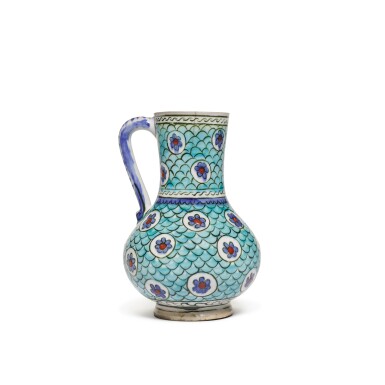
An Iznik polychrome pottery jug, Turkey, circa 1580
Estimate
25,000 - 35,000 GBP
Lot Details
Description
of baluster form with slightly everted neck and loop handle, painted in underglaze turquoise-blue, cobalt-blue, and bole-red outlined in black, decorated with roundels enclosing flowerheads on a fish-scale ground, the foot with Ralph Brocklebank collection label dated November 1916 and old [Durlacher] label, dated 30.11.97
20.5cm. height
Durlacher Brothers, London, by 1897
Ex-collection Ralph Brocklebank (1840-1921), Haughton, Cheshire, by November 1916;
Thence by descent
The fishscale pattern is found in Iznik pottery as early as the 1530s as seen on a blue-and-white candlestick in the form of a fish in the Benaki Museum (inv. no.10). It is thought that maiolica pottery produced in Deruta, Italy in the early sixteenth century inspired this motif in Iznik (see MET Museum, acc. no.1975.1.1039).
Fishscales were a popular pattern in Iznik pottery, often applied to cover the ground of vessels where it was employed using different styles and colours. A jug sold at Christie’s, London, 28 October 2021, lot 86, shows a fish-scale pattern ground in cobalt-blue, decorated with cintamani and lobed cartouches. A dish in the British Museum (inv. no.G.80) is decorated with fishscales in green surrounding cintamani and cartouches enclosing flowerheads, and a dish with fishscales in cobalt was sold in these rooms, 25 October 2023, lot 131.
The present jug is a rare example painted in a delicate shade of turquoise surrounding charming flower roundels. Slight variations in the thickness of the lines allow us to trace the movement of the brushstrokes, revealing a potter working quickly but confidently which lends a sense of animation to the fish-scale ground.
You May Also Like


