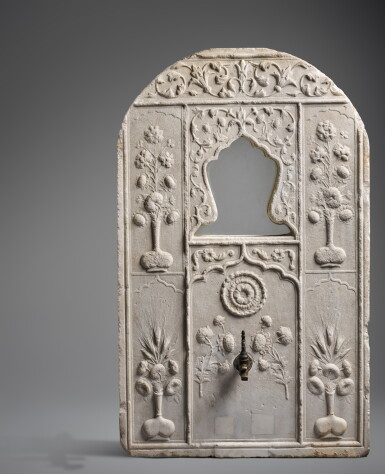
An Ottoman 'Tulip Period' marble fountain, Turkey, 18th century
Estimate
50,000 - 70,000 USD
Lot Details
Description
An Ottoman 'Tulip Period' Marble Fountain, Turkey, 18th Century
of rectangular shape with a rounded upper section, the white marble decorated with arabesques, carved tulips and ranunculi in vases, the central section with a carved niche mounted with a brass tap, surmounted by a mirror in an arched cavity
48⅞ by 29⅞ in.
124 by 76 cm
Robert Kime (1946-2022);
Anonymous sale, Sotheby's, London, 24 April 2024, lot 191;
Where acquired by the present collector.
The present fountain displays characteristic features of the Ottoman 'Tulip Period' architecture from the early 18th century. This naturalistic decorative repertoire derives from the Edirnekārī technique that emerged in the second half of the seventeenth century in relation with contemporary European art. The floral imagery of tulips and ranunculi in vase was introduced in architecture during the reign of Sultan Ahmed III (r.1703-30), as visible in the so-called 'Fruit Room' in the Topkapi Palace. Other contemporary marble fountains were decorated in the same style, including the Sultan Ahmed III fountain in front of the Topkapi palace and the Tophane fountain in the Beyoglu district.
These fountains share a common feature inspired from the Safavid and Mughal chini-khana, a "space with recessed niches designed specifically for the display of precious vessels" (M.S. Graves and B. Junod 2011, p.348). On the present fountain, vases are similarly displayed in cut-out mihrab-like arched niches.
You May Also Like