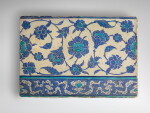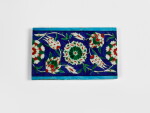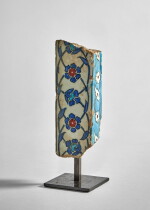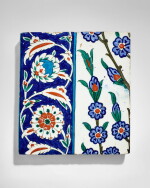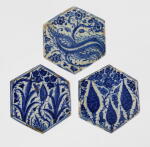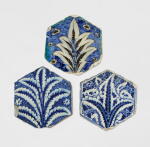
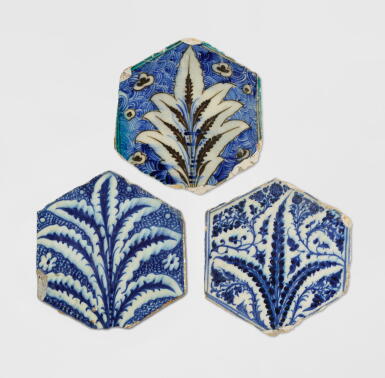
Three Mamluk Hexagonal Pottery Tiles, Syria, Mid-15th Century
Estimate
10,000 - 15,000 USD
Lot Details
Description
Three Mamluk Hexagonal Pottery Tiles, Syria, Mid-15th Century
two decorated in underglaze cobalt blue on a white ground with large serrated leaves, the third decorated in underglaze cobalt-blue, black and turquoise with similar serrated leaves
Largest 7¼ in.
18.8 cm
Lockwood de Forest, late 19th century;
Thence by descent until sold, Christie’s, London, 26 April 2018, lot 23;
Where acquired by the present collector.
A closely comparable panel of fern-decorated Mamluk tiles, attributed to Damascus and dated circa 1420-50, is preserved in the V&A Museum (inv. no. 422-1898). The present tiles were formerly in the collection of Lockwood de Forest, the American artist and designer who was one of the pioneering American collectors of Mamluk tiles. Through his interior designs and collecting habits, he helped foster an appreciation for Islamic and Indian art in Gilded Age America. In the 1880s, he purchased more than 1,200 Mamluk tiles in Damascus, using them to decorate the houses of his clients as well as his own (Carswell, ‘Six Tiles’, in Richard Ettinghausen (ed.), Islamic Art at the Metropolitan Museum of Art, New York, 1972, p. 104). He is also remembered for his collaboration with Louis Comfort Tiffany, with whom he shared a fascination for Islamic art and design, incorporating motifs derived from Islamic art into their work.
You May Also Like