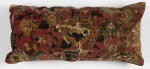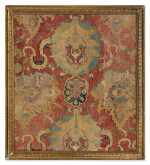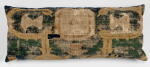
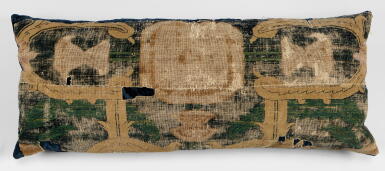
A Mughal Carpet Fragment, probably Lahore, India, Late 17th Century
Estimate
2,500 - 3,500 USD
Lot Details
Description
A Mughal Carpet Fragment, probably Lahore, India, Late 17th Century
mounted on a blue jacquard velvet cushion
approximately 3ft. 11in. by 1ft. 8in.
119 by 50 cm
Anonymous sale, Christie's, London, 19 April 2016, lot 77;
Where acquired by the present collector.
The fragment once formed part of the border of a magnificent carpet thought to have been woven for the Chihil Sutun Palace, Isfahan. Two further fragments from this carpet, now joined together, are in the Philadelphia Museum of Art (The Joseph Lees Williams Memorial Collection, inv.no. 1955-65-34, see Ellis, Charles Grant, Oriental Carpets in the Philadelphia Museum of Art, Philadelphia, 1988, No. 64, pp.228-235. F. R. Martin recorded in 1908, that the carpet from which the Philadelphia border fragments came from had a red main field and was of Indian Imperial manufacture from Lahore, of which numerous fragments had appeared in bazaars of Constantinople (including S. Haim, and Benguiat auction 1925). It was considered originally to be one of the largest carpets of singular design and was noted initially by Kendrick in 1922 to have been more than 70ft by 30ft (and then by Sir Cecil Smith to be 59 by 29ft) and was legendarily made for Shah Abbas (r.1586-1628) for use in the Hall of the Forty Columns (Chihil Sutun), Isfahan. The present fragment displays the entire width of the side border testifying to the exceptional scale of the original carpet.
There was a fire in 1700 which damaged the carpet, and it was last seen preserved in part in 1887, and now survives as fragments widely dispersed in international museum collections: the Museum of Decorative Arts in Frankfurt (originally sold in the Benguiat sale, American Art Association, XV-XVIII Century Rugs, Paris & New York, 1925, pl.17); the University Museum of the University of Pennsylvania, Philadelphia; the Musée du Louvre, Paris; Ethnographic Museum, Munich; the Cincinnati At Museum, the Philadelphia Museum of Art, and the Museum of Turkish and Islamic Art (TIEM), Istanbul. A large border section was also sold in the 1925 Benguiat sale, American Art Association, XV-XVIII Century Rugs, Paris & New York, 1925, pl.1.
You May Also Like