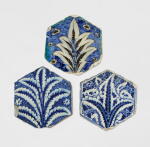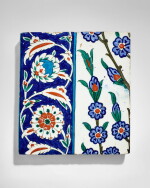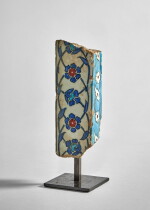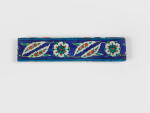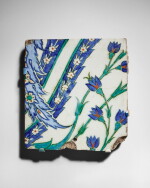
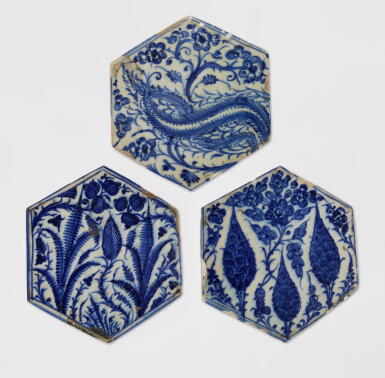
Three Mamluk Hexagonal Pottery Tiles, Syria, Mid-15th Century
Estimate
20,000 - 30,000 USD
Lot Details
Description
Three Mamluk Hexagonal Pottery Tiles, Syria, Mid-15th Century
each tile decorated in underglaze cobalt blue on a white ground with various designs of leafy fronds and foliate vegetation
each 7½ in.
19 cm
Paul Ispenian, Cairo and Alexandria, circa 1900;
Georges Antaki, Europe;
Oliver Hoare (1945-2018), London;
Sotheby’s, London, 31 March 2021, lot 71;
Where acquired by the present collector.
The blue-and-white palette, together with the fluid vegetal ornament, reflects the influence of fifteenth-century Chinese export porcelains. Once variously attributed to Egypt and Syria, such tiles are now generally accepted as products of Damascus, based on surviving in situ tiles and the documented provenances of major museum collections. Notable examples include those of the Museum of Islamic Art, Cairo, and the V&A Museum, London. For further discussion of Mamluk tiles, see Carswell, ‘Six Tiles’, in Ettinghausen (ed.), Islamic Art in the Metropolitan Museum of Art, New York, 1972, p. 99, and Gibbs, ‘Mamluk Ceramics’, Transactions of the Oriental Ceramic Society, 63, 1998-99.
You May Also Like