An Iznik Pottery Tile, Turkey, circa 1580
Estimate
120,000 - 180,000 USD
Lot Details
Description
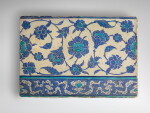
An Iznik Pottery Tile, Turkey, circa 1580
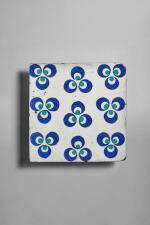
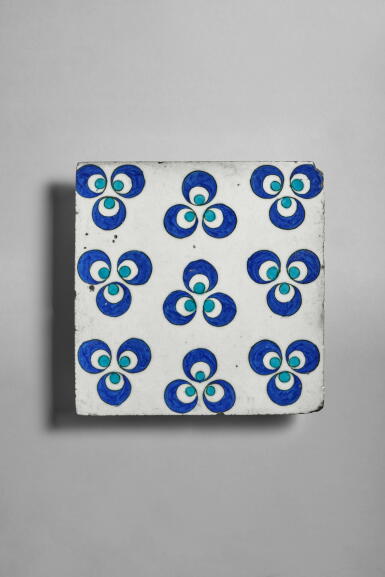
of square form, decorated in underglaze cobalt-blue and turquoise, outlined in black, on a white ground, with offset rows of çintamani
10 ¾ by 11 in.
27.4 by 28 cm
Heinrich Jacoby (1889-1964), Germany and Switzerland, thence by descent;
Anonymous sale, Christie's, London, 25 October 2018, lot 217;
Where acquired by the present collector.
Die Petag Im Dienste Ihrer Kunden, Frankfurt, 1961 (front cover);
'Autumn auction reflections', HALI, issue 198, 2018, pp.122-5, reproduced p.125.
The Ottoman çintamani (‘auspicious jewel’) motif is the pattern of a triangle of three spots and a pair of wavy bands. It is arguably the most distinct and striking device used in the Ottoman arts. The unknown age and source of this pattern may predate Ottoman rule by over a thousand years. This motif was a Tamga, sign or brand used by Tamerlane (1336-1405), and Ruy Gonzalez de Clavijo, a Spanish envoy to Samarqand, recorded that Tamerlane used the device on his coinage and property. The motif can be traced back to the Buddhist period in China, and had a different association, with the circles representing pearls and the bands, flames, waves or halo-like sanctity. Known as the çintamani in the Ottoman Empire, the pair of wavy bands are associated with the tiger-stripes and the spots alluded to leopard spots (pelengi – leopard like). Leopard pelts being the clothing of heroes in Persian tradition. The çintamani became associated with rulership, strength and power, and the mani (spots) symbolic of purity. The ancient associations evolved into a general token of good luck.
The decorative motif was used by Ottoman court artists in all media and in compositions that varied with almost every period from the 15th century onwards. It also appeared in traditional Anatolian rug designs under Sultan Selim I (1512-20) and thereafter became more widespread in Central Asia. The motif is most often employed in border tiles (see lot 23 in the present sale) and far fewer examples of large, square-format Iznik tiles with the motif are recorded. One example, where the cintamani is reproduced with a red and green center is published in Y. Petsopoulos, Tulips, Arabesques and Turbans, London, 1982, pl.54.
The arrangement of the çintamani on this tile in alternating rotations is similar to the design of two Ottoman velvets, see Sotheby’s, 26 April 2017, lot 139, and David Collection, Copenhagen (inv. no.25/1962). In both of these velvets, the weaver has paired the roundels with accompanying tiger stripes and, in the Copenhagen velvet, cloud bands. The potter here has exercised restraint in order to imbue the tile with remarkable graphic power. The roundels sit freely and confidently against the white ground, and each motif is produced in a monochromatic ton-sur-ton palette of turquoise and cobalt, outlined in black. The rotation of the orientation in each column implies an upwards and downwards movement that lends a sense of immediacy to the design and offers a glimpse into the dazzling effect these tiles would have had mounted in sequence.
Provenance features prominently throughout the Magnum Opus collection. The scale, colour, technique, and beauty of many of the works is further imbued with the names of great collectors. This is true of the present tile, which was formerly owned by Heinrich Jacoby, a prominent carpet dealer and collector whose own collection of classical carpets was published in 1923 (H. Jacoby, Eine Sammlung Orientalischer Teppiche, Berlin, 1923). Tiles feature prominently in Jacoby’s 1923 publication, often illustrated in tandem with the classical carpets he assembled and used as a reference in discussions on their design. Jacoby owned a fragment of a closely related çintamani tile to the present lot which was published in his catalogue (see Jacoby, op. cit., no.23).
Heinrich Jacoby was the leading force behind PETAG (Persische Teppiche Aktien Gesellschaft), a Berlin-based carpet firm founded in 1911. They established a workshop in Tabriz in order to produce high quality carpets that countered the decline associated with mass carpet production in the late 19th century. PETAG produced luxurious weavings often for a European clientele that presented classical designs of courtly carpets that were becoming more widely published in major reference books at the turn of the century. Each PETAG carpet is woven with a çintamani signature, usually in the border. This logo was drawn from the present tile from Jacoby’s own collection, which was published on the front cover of PETAG’s 1961 marketing material. Its use clearly signals the luxury of these courtly carpets from museum holdings and Jacoby’s own collection that informed the firm’s designs and success.
You May Also Like