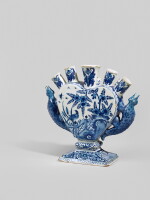
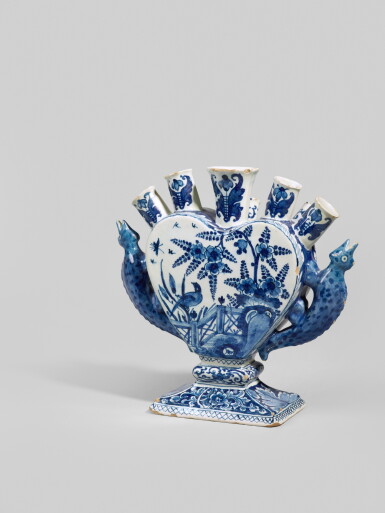
A Dutch Delft Blue and White Flower Vase, circa 1700-10
Estimate
7,000 - 10,000 USD
Lot Details
Description
A Dutch Delft Blue and White Flower Vase, circa 1700-10
of heart shape, painted on the front with a vignette of a female figure amongst flowers, holding a cornucopia of further flowers, the verso with a stylized panel of a fenced garden with a bird perched on a branch, the top of the vase surmounted with eight nozzle spouts in two rows, flanked by two salamander-shaped handles, raised on a spreading rectangular pedestal foot, LVE monogram mark in blue for Lambertus van Eenhoorn, owner of De Metaale Pot (The Metal Pot) factory over numerals 12, and numeral 3
height 9 5/8 in.
24.4 cm
Salomon Stodel, Amsterdam, bearing label;
From whom acquired by the present collector at TEFAF Maastricht on 4 July, 2022.
Regarded as among the most iconic and technically accomplished creations of the Delft ceramic industry, flower pyramids and spouted vases were first produced in the 1680s and 1690s for Queen Mary II, wife of the stadtholder-king William III, who favoured them as decorative furnishings in her palaces. Fragments of both tiered spouted vases and pyramid-shaped examples have been excavated from Mary’s private gardens at Het Loo Palace, while contemporary inventories compiled during the royal couple’s moves between residences further attest to their widespread use in her apartments. Mary’s patronage of Delft potteries helped stimulate demand for these innovative forms, encouraging manufacturers to devise increasingly elaborate designs.
A further example of this form, attributed to Adrianus Kocx, the owner of De Grieksche A (The Greek A) factory is with Aronson Delftware, Amsterdam, formerly sold at Sotheby’s, New York, 31 October 1981, lot 26. The figure holding a cornucopia seen on the present vase also appears on a second flower vase from De Metaale Pot, marked for Cornelis Koppens and dating to circa 1730. That example is illustrated by R. Aronson and C. Ariaans in Tulips, Oysters & Choux Pastry: Delftware (Amsterdam, 2022), pp. 36-37, no. 11
You May Also Like


