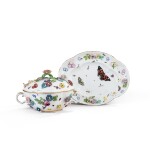
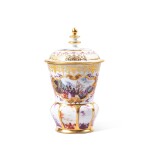
A Meissen porcelain gilt-metal-mounted lilac-ground chocolate pot and cover, circa 1740
No reserve
Lot closes
June 25, 11:04 AM GMT
Estimate
3,000 - 5,000 EUR
Current Bid
300 EUR
1 Bid
No reserve
We may charge or debit your saved payment method subject to the terms set out in our Conditions of Business for Buyers.
Read more.Lot Details
Description
cylindrical form, with a gilt-edged scroll-moulded spout at the front and a similarly moulded handle base at the side, reserved with panels of merchants on quaysides, flanked by sprays of indianische Blumen against the lilac ground, the sprung cover and porcelain handle with gilt metal-mounts, with turned wood handle, letter J. in iron-red to both pieces, impressed numerals 21 to chocolate pot, the fittings later
Height 5 ⅝ in; 14,4 cm
Anonymous sale, Christie’s, London, 24 March 1969, lot 50;
The Property of a Gentleman, Sotheby’s, London, 10 July 1973, lot 97;
Anonymous sale, Woolley & Wallis, Salisbury, 25 February 2014, lot 340.
The present chocolate pot was first offered at Sotheby’s, London, on 10 July 1973, accompanied by much of its original service, which comprised seven teabowls and saucers, a pair of chocolate cups and saucers, a sugar bowl and cover, a waste bowl, a teapot stand, and a hot milk jug cover (lots 91–98). Elements of the service had appeared earlier at Christie’s in 1969, including the present chocolate pot, while the teapot from the service was sold at Sotheby’s, London, 18 November 1969 (lot 71).
In subsequent years, individual pieces from the service have re-emerged at auction. A teabowl and saucer was sold at Christie’s, London, on 9 July 2019 (lot 90), and another example in the same salerooms on 4 July 2013 (lot 323). A bell-shaped chocolate cup, likely from the original service and formerly in the Hoffmeister Collection, was sold at Bonhams, London, 24 November 2010 (lot 98).
Cranfield University used non-invasive X-ray fluorescence (XRF) for this lot to screen the green enamel for chromium, which was not detected, a result consistent with 18th century manufacture.