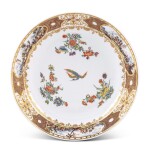
A Meissen porcelain armorial circular dish from the 'Swan' Service, circa 1738-39
Live auction begins on:
June 24, 12:30 PM GMT
Estimate
10,000 - 15,000 EUR
Lot Details
Description
modelled by J. J. Kändler, in low relief with two swimming swans among bulrushes with a crane in flight above, upon a spiral shell-moulded ground, the rim painted with the Brühl and Kolowrat-Krakowska arms and scattered flower sprigs, with a gilt border to the rim, crossed swords mark in underglaze-blue, impressed Dreher's mark of a + in a circle, indistinct incised mark II
Diameter 12 in; 30,5 cm
From the service commissioned by Heinrich Graf von Brühl (1700-63);
Thence by descent in the von Brühl family at Schloss Pförten;
Possibly among the pieces from the service lost in 1945 from Schloss Pförten;
Kunsthandel Steinbeck, Aachen, by repute;
A Private Collection Hamburg, acquired from the above until sold, Van Ham Cologne, 17 May 2023, lot 1054 (sold following a settlement agreement with the heir of Friedrich-Joseph Graf von Brühl (1875 -1949);
Acquired at the above sale.
The celebrated Meissen ‘Swan’ Service was commissioned by Heinrich, Count von Brühl (1700–1763), Chief Receiver of Taxes to Augustus the Strong, King of Poland and Elector of Saxony, Prime Minister to Augustus III, and Director of the Royal Porcelain Manufactory at Meissen. Ordered in 1736, the service prominently displays the combined arms of Count von Brühl and his wife, Maria Anna Franziska Kolowrath-Krakowski (1717–1762), whom he married on 29 April 1734. An entry in the Meissen factory records for May 1736 notes ‘widerumb ein neues Taffel Servis vor des H: Geh: Cabinet Minister von Brühl Excellenz von ganz neuer Façon verlanget worden’ [A new table service was ordered for his Excellency the Privy Cabinet Minister von Brühl of entirely new design], underscoring both the novelty and ambition of the project.
Distinguished by virtuoso modelling, lavish gilding, and extraordinary scale—amounting to approximately 2,200 pieces—the service stands as one of the most ambitious porcelain undertakings of the eighteenth century. It functioned not only as a supreme emblem of Brühl’s rank and magnificence, befitting his reputation for opulent courtly entertainments, but also as a calculated demonstration of the technical and artistic capabilities of the Meissen manufactory under his directorship.
Design development continued until 1738. The work records of the chief modeller Johann Joachim Kändler document that between 13 July 1737 and 17 January 1738 no fewer than forty-six experimental plate designs were produced as trials. Production of the plates commenced in 1737–38, and the full service was completed in 1742 through the collaboration of Kändler, Johann Friedrich Eberlein, and Johann Gottlieb Ehder. The ensemble comprised an extensive range of dinner and dessert wares, including elaborate centrepieces, sculptural tureens, vases, candlesticks, oval serving dishes, plates, sauceboats, wine and bottle coolers, domed covers, sugar bowls, and shell-shaped dishes.
Baroque in conception, the plates and dishes are unified by a richly moulded relief of paired swans facing one another amid undulating waves and rushes. The symbolic resonance of the swan in seventeenth- and eighteenth-century visual culture—encompassing mythological associations, Enlightenment interest in nature, and connotations of beauty and love—has been examined in detail by Lothar and Sigrid Dittrich in Schwanenservice, Meissener Porzellan für Graf von Brühl, exh. cat., Leipzig, 2000, edited by Ulrich Pietsch. While the relief was long thought to derive from an engraving published in Johann Leonhard Buggel’s Neu-vollständiges Reiss-Buch (Nuremberg, 1700), Maureen Cassidy-Geiger demonstrated that its true source is an etching by Wenceslaus Hollar, after a design by Francis Barlow, first issued in 1654 (see Maureen-Cassidy-Geiger, ‘From Barlow to Buggel: A New Source for the Swan Service’, Keramos, 119, January 1988, pp. 64-68). It has further been suggested that the pervasive aquatic imagery may allude to the literal meaning of the name Brühl, translated as ‘swampy meadow’ or ‘marshy ground’.
Three dishes of this size formed part of the Nelson and Happy Rockefeller Collection and were sold at Sotheby’s, New York, A Collecting Legacy: Property from the Collection of Nelson & Happy Rockefeller, 18 January 2019, lots 362, 363 and 364. Further extant dishes of this size are recorded in Ulrich Pietsch (ed.), Schwanenservice – Meissener Porzellan für Heinrich Graf von Brühl, exh. cat., Leipzig, 2000, p. 157, cat. no. 26.
Cranfield University used non-invasive X-ray fluorescence (XRF) for this lot to screen the green enamel for chromium, which was not detected, a result consistent with 18th century manufacture.