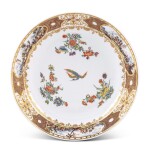
A Meissen porcelain Kakiemon 'Hob in the Well' dodecagonal dish, circa 1730
Live auction begins on:
June 24, 12:30 PM GMT
Estimate
10,000 - 15,000 EUR
Lot Details
Description
painted with a scene from the life of Shiba Onkô, the youth about to throw a stone at a large jar to rescue his drowning friend, within a floral and foliate border below the brown-edged rim, erased blue enamel crossed swords mark, Dreher's mark of a + in a circle three times
Width 10 ¼ in; diam. 26 cm
Anonymous sale, Christie's, London, 21 February 2005, lot 50;
Anonymous sale, Sotheby’s, Paris, 16 April 2013, lot 121;
Acquired at the above sale.
Porcelains of this type, largely derived from Japanese Kakiemon prototypes in the Japanese Palace collection of Augustus the Strong and distinguished by crossed swords marks painted in blue enamel rather than underglaze-blue, formed part of a substantial order negotiated around 1729–30 between the director of the Meissen manufactory, Count Hoym, and the Paris marchand-mercier Rudolph Lemaire. The wares were intended for the French market, where they were to be offered as highly sought-after Japanese originals. The enterprise was short-lived: royal suspicion surrounding the arrangement led to Hoym’s fall from favour and subsequent exile, while Lemaire was arrested and ultimately expelled. The porcelains remaining in Hoym’s Dresden residence were confiscated by royal order and absorbed into the Saxon Royal Collection, at which point they were assigned inventory numbers for the Japanese Palace. A comprehensive explanation and discussion of the entire Hoym-Lemaire affair is provided by Julia Weber, in a paper presented at the International Ceramics Fair and Seminar, London, 16 June 2012, 'A detective story: Meissen porcelains copying East Asian models. Fakes or originals in their own right?' and published the following year in the Fair's Catalogue, pp. 41-49.
The 1770 inventory of the Japanese Palace lists dishes of this type under numerals 35, and 153: "Vier und Zwanzig Stück detto [12 eckichte Schaalen] 2 3/4 Zoll tief, 10 Zoll in Diam. No 35", [Twenty-four [12 sided dishes] (painted inside with pagodas)...No 35], Boltz, 1996, p. 72. One such dish bearing inventory number 35 from the Oppenheimer Collection, sold, Sotheby’s, New York, 14 September 2021, lot 26.