
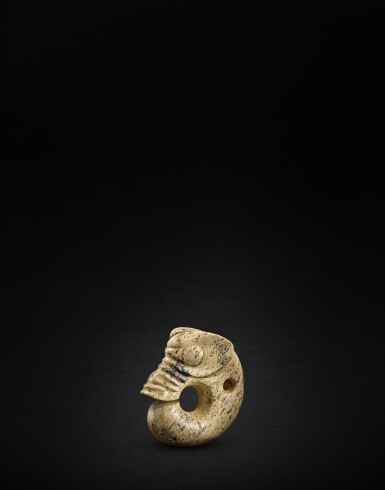
A jade pig-dragon, Neolithic period, Hongshan culture | 新石器時代 紅山文化 玉豬龍
Estimate
600,000 - 1,200,000 HKD
Lot Details
Description
6.1 cm
The present carving depicts a zhulong, or pig-dragon, a modern term that describes the animal’s upturned snout, prominent bulging eyes and coiled body. Considered to represent the prototype of depictions of mythological dragons in later Chinese art, zhulong are some of the most interesting creations of the enigmatic Hongshan culture (c. 3500 BC), and evidence the existence of a complex system of belief in supernatural forces.
Jade zhulong have been discovered at various tomb sites across Northern China, often found placed on the chest of the deceased, indicating their use as chest ornaments. These carvings were analyzed by Elizabeth Childs-Johnson in her article, Jades of the Hongshan Culture, published in Arts Asiatiques (vol. XLVI, December 1991, pp. 82-95). She identified the Liaoxi and Liaodong peninsulas, as well as the upper and lower valleys of the Liao River, as the primary regions where Hongshan cultural remains, including these zhulong, were found. While their exact function remains uncertain, fragments of a zhulong were unearthed at a fertility temple complex in Niuheliang, Kezuo, Liaoning province, suggesting a possible connection to fertility rituals.
See a larger example in the Liaoning Provincial Institute of Archaeology and Cultural Relics is illustrated in Hongshan wenhua yuqi jianshang [Connoisseurship of jades from the Hongshan culture], Beijing, 2014, p. 94, no. 1; and another in the Tianjin Museum, published in Tianjin shi yishu bowuguan cang. Yu [Jades in the Tianjin Museum], Hong Kong, 1993, pl. 7.
豬鼻大目、身體蜷曲如龍,因形似豬與龍而得名「豬龍」,被認為可能是中國藝術中「龍」形象的原型,也是紅山文化(約公元前3500年)最具代表性的文物之一,象徵紅山文化成熟且複雜的信仰體系。
中國北方多處墓葬遺址曾發現玉豬龍,多被置於墓主胸前,可推測其原為佩掛於胸部的器物。Elizabeth Childs-Johnson 在〈Jades of the Hongshan Culture〉一文中(發表於《Arts Asiatiques》,卷XLVI,1991年12月,頁82-95),指出遼西、遼東半島及遼河上、下游流域為紅山文化的發源地。雖然玉豬龍的原始用途尚不明確,但在遼寧牛河梁遺址的女神廟中出土的玉豬龍殘片,可能暗示其與繁衍生殖相關的祭祀活動有一定聯繫。參看遼寧省文物考古研究所藏一例,尺寸更大,錄於《紅山文化玉器鑑賞》,北京,2014年,頁94,編號1;天津博物館藏一例,載於《天津市藝術博物館藏玉》,香港,1993年,圖版7。
You May Also Like


