
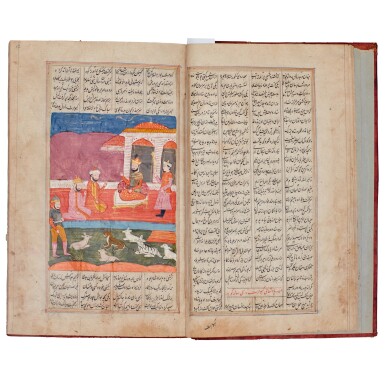
Abu'l Qasim Firdausi (d.1205 AD), Shahnameh, North India, Kashmir, 18th century
Estimate
8,000 - 12,000 GBP
Lot Details
Description
Persian manuscript on paper, 289 folios plus 2 flyleaves, 25 lines to the page written in black nasta'liq script. titles in red over two columns, margins ruled in black and polychrome, three illuminated headpieces, with sixteen paintings in gouache and gold, in contemporaneous red morocco binding sewn on four cords
32 by 20cm.
Ex-Schoyen Collection, Norway, acquired 2006
By the eighteenth century, Kashmir had emerged as an important centre for the production of Persian manuscripts under Mughal and post-Mughal patronage. Copies of the Shahnameh produced in the region reflect a synthesis of earlier Safavid models with distinctly local stylistic developments.
The present manuscript belongs to this tradition. Its layout, with text in four columns follows established Persian conventions, while the palette and decorative vocabulary point to a Kashmiri atelier. A particularly close comparison may be drawn with the Shahnameh manuscript in the Library of Congress, Washington, D.C. (Control Number 2012498868). This manuscript, dated to the seventeenth-eighteenth century, shares with the present example a number of defining stylistic features, including the nastaʿlīq script.
Kashmiri Shahnameh manuscripts of the eighteenth century often display an engaging blend of provincial Mughal and lingering Persianate aesthetics. Figures tend to be more compact, compositions more intimate, and landscape elements, such as stylised rocks and sparse vegetation, simplified when compared to earlier Safavid prototypes. At the same time, the continued inclusion of narrative painting underscores the enduring appeal of the epic’s heroic cycles. Even when less lavish than imperial Safavid precedents, Kashmiri copies retain a refined elegance, demonstrating the persistence of the arts of the book in regional centres well into the late eighteenth century.
You May Also Like


