
Property from an East Coast Private Collector
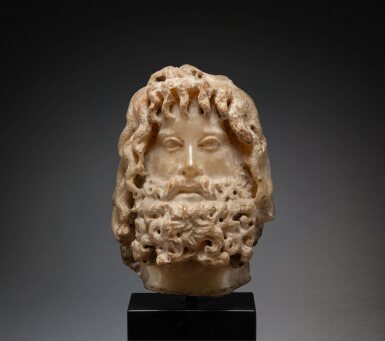
A Roman Alabaster Head of Sarapis, circa 2nd century A.D.
Live auction begins on:
February 6, 03:00 PM GMT
Estimate
5,000 - 7,000 USD
Bid
5,000 USD
Lot Details
Description
Property from an East Coast Private Collector
A Roman Alabaster Head of Sarapis, circa 2nd century A.D.
based on a monumental cult statue by Alkamenes, with thick beard of drilled voluted curls, and long wavy hair with undercut curls falling down over the forehead.
Height: 4 ½ in.; 11.4 cm
Arnold Seligmann, Rey & Co., New York
Brummer Gallery, New York, on consignment from the above, November 2nd, 1925 (inv. no. X208), and later personally given by Emile Rey to either Ernest or Joseph Brummer (inv. no. N4314: https://libmma.contentdm.oclc.org/digital/collection/p16028coll9/id/15948/rec/28)
H. Khan Monif, New York (inv. no. 605), acquired from the above on October 30th, 1948
Richard "Max" Miller, Miami, acquired from the above on February 2nd, 1950
then by descent to the present owner
The Brooklyn Museum, Brooklyn Institute of Art and Sciences, New York, Paganism and Christianity in Egypt, January 23rd-March 9th, 1941
Pagan and Christian Egypt: Egyptian Art from the 1st to the 10th Century A.D., exh. cat., Brooklyn Museum, Brooklyn Institute of Arts and Sciences, 1941
Sarapis was a syncretic Greco-Egyptian deity created under the Ptolemies, combining aspects of Osiris-Apis with Greek gods such as Zeus and Hades, and worshipped as a god of fertility, healing, and the afterlife throughout the Roman world. The present head reflects the canonical type ultimately derived from the cult statue traditionally attributed to Alkamenes, with its mature bearded visage and calm, authoritative expression. For a close comparison of this sculptural type, see the head of Sarapis in the Walters Art Museum, Baltimore: https://art.thewalters.org/object/23.120/ The present head was probably once part of a bust, with the god's shoulders clad in a chiton and himation (e.g., see W. Hornbostel, Sarapis, 1973, fig. 248, and Sotheby's, London, July 9th, 2020, no. 31).
You May Also Like


