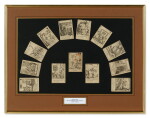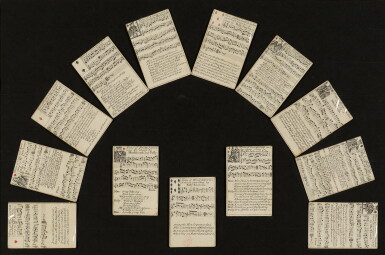
Playing cards — With music and lyrics from John Gay's "The Beggar's Opera"
(London: John Bowles, circa 1728)
Estimate
10,000 - 15,000 USD
Lot Details
Description
Playing cards — Music and lyrics from John Gay's "The Beggar's Opera"
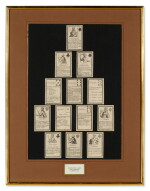
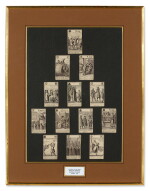
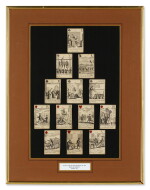
52 playing cards. Engravings on paper, red hand-colored hearts and diamonds, red ink tax stamp on the ten of spades, versos blank; some light soiling and a few pale stains. 13 of the cards are framed, the rest are housed in archival sleeves in a folder affixed to the rear of the frame.
3 ⅝ by 2 ½ in. (each card); 20 by 26 in. (frame)
9.5 x 6.25 cm; 51 x 66.5 cm
Jaime Ortiz-Patiño (Sotheby's, London, 10 December 2013, English literature, history, children's books and illustrations, lot 236);
Acquired at the above sale by the present collector
Jaime Ortiz-Patiño Collection of Early Playing Cards #13;
Mann, Sylvia. All Cards on the Table (Marburg 1990) #264;
Hargrave, Catherine Perry, A History of Playing Cards and a Bibliography of Cards and Gaming, Boston 1930, pp.97-201
A musical deck of playing cards based on John Gay's popular satire, The Beggar's Opera, published soon after it premiered.
John Gay's The Beggar's Opera opened at Lincoln's Inn Fields Theatre on 29 January, 1728 and instantly became a smash hit. It featured familiar ballad-style songs sung by characters who were everyday people, lampooning both Italian opera and English society in one fell swoop. John Bowles, a successful London map, print, and game seller, sought to capitalize on the opera's popularity with this deck of cards. His deck has two distinct uses — one could play any of the normal card games with it or, using the printed music and lyrics, one could gather around the piano to sing and play snippets from the opera's ballads.
The Beggar's Opera remained in vogue throughout the nineteenth century, and Bowles' heirs would continue to print versions of this deck, including one in circa 1765 and one in 1795.
Polly: What then in Love can Woman do
Lucy: If we grow fond, they shun us
Polly: And when we fly them, they pursue
Lucy: But leave us when they've won us.
You May Also Like