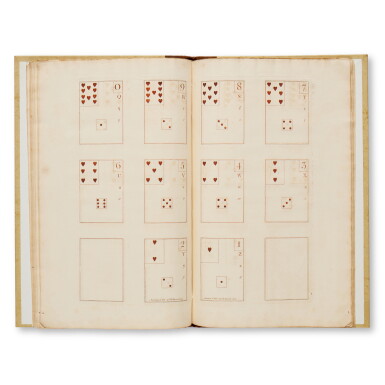
Playing Cards; Thomas Foubert — A bound copy of "The Litterary Cards..."
London: Thomas Foubert, 1758
Estimate
4,000 - 6,000 USD
Lot Details
Description
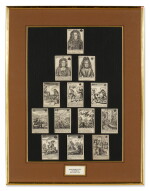
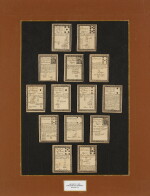
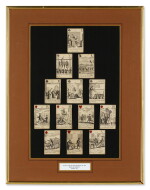
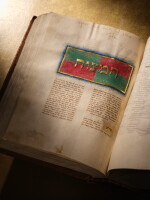
Playing cards; Thomas Foubert — The litterary cards, being a new invention to learn to read, and speedily acquire the greatest knowledge in calculation without pains or trouble... Wrote in French and English.
Folio, engraved frontispiece, woodcut device on title-page, typographic text in English and French, 20 engraved plates each containing 6 cards, some with handcolored hearts and diamonds, some printed in red, a few cards left blank; short tear to the fore-edge of the title, a tiny hole in lower right corner passing through the whole of the textblock, a few minor instances of soiling, light offsetting from the plates, the portrait excised from one card. Modern calf-backed boards with a printed title label pasted to the upper cover and a spine label.
15 in. by 9¼ in
38.5 cm by 23.5 cm
George Moffat (bookplate)
Jaime Ortiz-Patiño (Sotheby's, London, 10 December 2013, English literature, history, children's books and illustrations,
lot 238)
Acquired at the above sale by the present collector
Jaime Ortiz-Patiño Collection of Early Playing Cards, #37;
English Short Title Catalogue, #T122891
Thomas Foubert's "litterary cards" could be used for playing a variety of games, as well as for teaching reading, arithmetic, and a diverse array of facts, quotations, and other information. For example, most of the cards feature a letter, allowing them to be used in a simple reading and writing game. The face cards include a small portrait of kings and queens or theatrical characters (the Jack of Hearts shows David Garrick in the role of Tancred, from the 1745 play Tancred and Sigismunda by James Thomson). There are also cards that feature a map of the world, musical notation, or multiplication tables. In addition to the suits and ranks, most cards have an image of a die face, allowing for a wider variety of games to be played using the deck, from backgammon to hazards and piquet. The text features rules and instructions for each of these games.
Foubert's deck was issued in book form to avoid the the Stamp Act of 1711's tax on cards and dice. The engraved cards could then be cut up and pasted onto card backs to form a usable deck of playing (see lot 36).
You May Also Like