Playing Cards — Arithmetical Cards
(London: John Lenthall and/or William Warter, 1711)
Estimate
10,000 - 15,000 USD
Lot Details
Description
Playing Cards — Arithmetical Cards
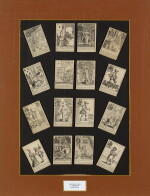
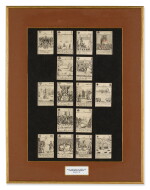
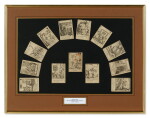
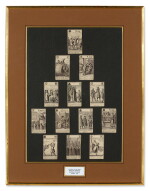
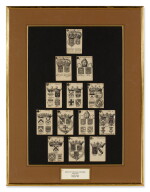
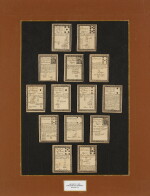
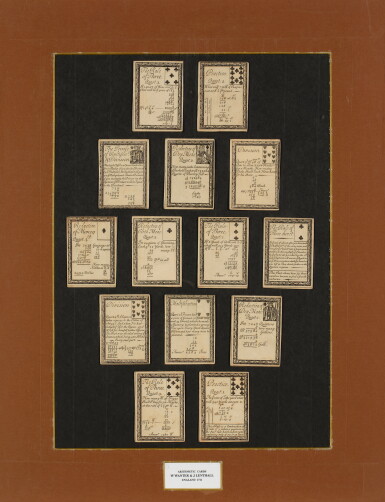
52 playing cards. Engravings on paper, with plain versos, red tax stamp on the ace of diamonds; occasional foxing, a few cards variously toned. 14 of the cards are mounted in a frame, the rest are housed in a folder attached to the back of the frame.
3 ½ by 2½ in. (cards); 26 by 20 in. (frame)
9 by 6.3 cm; 66.2 by 51 cm
Jaime Ortiz-Patiño (Sotheby's, London, 10 December 2013, English literature, history, children's books and illustrations, lot 229)
Acquired at the above sale by the present collector
Jaime Ortiz-Patiño Collection of Early Playing Cards, #42;
Mann, Sylvia, All Cards on the Table: Standard Playing Cards of the World and Their History, Leinfelden-Echterdingen Germany 1990, #259
A deck of playing cards designed to also teach practical arithmetic. The four suits are given over to different areas of arithmetic, with the Spades dealing with conversions between various systems (including the ins-and-outs of English coinage), Hearts multiplication and division, Diamonds adding and subtracting, and the Clubs contain practice questions and mathematical rules pertaining the previous subjects.
William Warter produced and sold playing cards from his stationers shop on London's Fleet Street from the 1670s until approximately 1708 or 1709. His shop was then taken over by his apprentice John Lenthall. Both cardmakers specialized in a fanciful decks that often featured decorative, political, or educational illustrations. They frequently engraved ornamental borders around their cards edges, as is the case here. There is no duty stamp on these cards, indicating that the deck was likely printed in 1711 or earlier.
You May Also Like