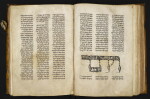
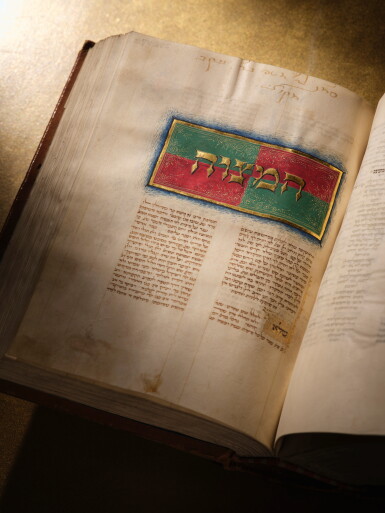
Sefer Mitzvot Gadol (Great Book of Commandments), Italy, late 15th century
Estimate
1,000,000 - 2,000,000 USD
Lot Details
Description
Sefer Mitzvot Gadol (Great Book of Commandments), by Moses of Coucy, Italy, late 15th century
Ink, gouache and gold leaf on parchment, 439 folios
A richly decorated Italian manuscript of one of the great monuments of medieval Jewish law.
Few works did more to shape the study and practice of Jewish law in medieval Ashkenaz than Moses of Coucy's Sefer Mitzvot Gadol (Great Book of Commandments), commonly known by the acronym Semag. Composed in thirteenth-century France, the work takes the traditional enumeration of the 613 commandments, 248 positive and 365 negative, as the framework for an expansive compendium of Jewish law. Each commandment is expounded through extensive discussion of the Talmud and earlier legal authorities, bringing a vast body of Jewish law within the organizing structure of the biblical commandments.
While the many surviving medieval manuscripts of this work testify to its authority and popularity, only about thirty-five preserve both major divisions; most surviving witnesses are partial or fragmentary. By the later fourteenth century, the work was firmly established in Italy, and the present codex belongs to this important Italian chapter in the transmission of a major monument of Ashkenazic learning. Modern textual study has shown that Moses of Coucy repeatedly revised the Semag and the medieval manuscript copies can therefore preserve valuable evidence for recovering its textual history.
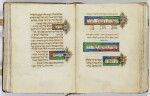
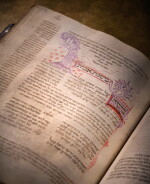
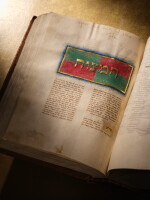
What primarily distinguishes the manuscript, however, is its strikingly visual character. Only a handful of the surviving copies of the Semag have been identified as containing substantial decoration or illustration, and the present codex belongs to this comparatively uncommon visual tradition. It is particularly notable for the use of gold and colored pigments to articulate the architecture of a legal text. Its principal divisions are announced by large gold letters set on painted fields of blue, red, or green and framed by narrow bands of gold and color. The opening word of the introduction appears in gold on blue; that of the positive commandments on a red ground; the opening word of the introduction to the negative commandments appears on alternating red and blue squares; and that of the negative commandments on a quartered field of red and green. Smaller textual divisions are marked by rectangular penwork frames and colored penwork flourishes in blue and red. Throughout the manuscript, words on the final lines frequently terminate in long descending pen flourishes, a number of which are elaborated into floral designs.
Photographs courtesy of Ardon Bar-Hama
You May Also Like