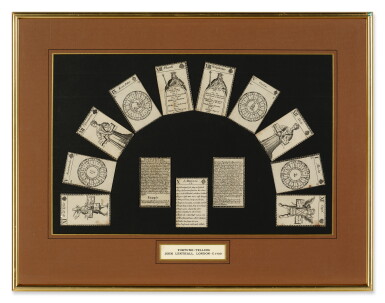
Playing Cards — Fortune Telling Cards
London: John Lenthall, (circa 1720)
Estimate
4,000 - 6,000 USD
Lot Details
Description
Playing Cards — Fortune Telling Cards
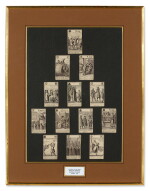
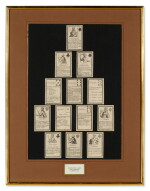
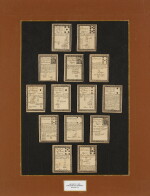
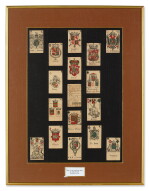
54 cards, including two instruction cards. Engravings on laid paper, red ink tax stamp on the ace of spades, plain versos; a few cards slightly stained, the eight of spades frayed on right hand side, with loss to the border but not the text. 13 of the cards are mounted in a frame, the rest are in archival sleeves housed in a folder attached to the back of the frame.
3½ by 2 ¼ in. (cards); 20 by 26 in. (frame)
9.25 by 5.75 cm; 51 by 66 cm
Jaime Ortiz-Patiño (Sotheby's, London, 10 December 2013, English literature, history, children's books and illustrations,
lot 234)
Acquired at the above sale by the present collector
Jaime Ortiz-Patiño Collection of Early Playing Cards, #33;
The Fournier Museum Catalogue, Volume I: British Isles, #26 (dating this set to 1690)
A rare and early deck of fortune telling cards.
These unusual cards are numbered and suited to be used as playing cards, but they also each feature the name of a royal, biblical, scientific, occult, religious, or historical figure at the top, including Herod, Dido, Wat Tyler, Copernicus, Cupid, and Dr. Faustus. The process for using this deck to divine the future is explained on the two instruction cards. One must begin by selecting a question from a tablet one of the four Kings cards — such as, "Whether they shall marry a gentleman or a tradesman," or "Whether they shall have a prosperous voyage." After following a complicated system of matching the numbers and letters associated with the questions to various other cards, from the sphere cards to the Queens or Jacks shown holding open books, the user is finally directed to an answer to their query which, of course, is a short rhyming verse — for example, "A trader rich, shall you bewitch," or "With all speed, you shall succeed."
Though originally published anonymously in around 1690, the deck was reissued by John Lenthall, the prominent London card, map, and printseller, sometime between 1711 and 1720. The dating is inferred from the red tax stamp, present here on the ace of spades.
You May Also Like