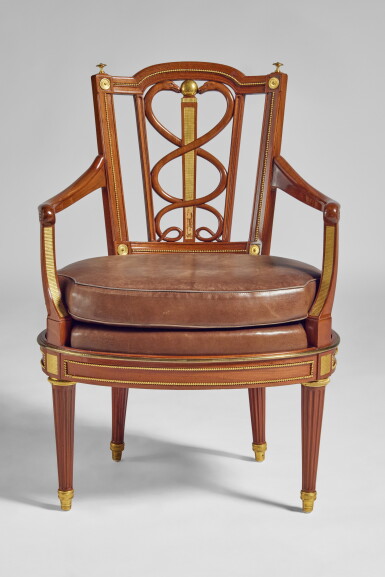
A German Neoclassical Brass-Mounted Mahogany Armchair Attributed to David Roentgen, Circa 1785
Estimate
30,000 - 50,000 USD
Lot Details
Description
A German Neoclassical Brass-Mounted Mahogany Armchair Attributed to David Roentgen, Circa 1785
of elliptical form; the concave back with caduceus splat and scrolling arms; the moulded seat rails with beaded brass borders; on circular tapering fluted legs; the inside front rail with black-painted inventory number 56008
height 35 in.; width 23 1/2 in.; depth 21 1/4 in.
89 cm; 59.5 cm; 54 cm
Galerie Aveline, Paris;
Paul and Jacqueline Desmarais Collection, New York;
Christie's New York, 30 April 2019, lot 90;
Where acquired by the present collector.
This highly inventive chair with its striking pierced back incorporating entwined serpents inspired by Hermes' caduceus was likely part of a larger suite of seat furniture, as other identical examples are recorded: a pair of armchairs from the Juan de Beistegui Collection old Christie’s Paris, 10 September 2018, lot 4; a single armchair from the London residence of Mrs Charles Wrightsman, sold Sotheby’s New York, 28 April 2010, lot 313 (possibly the chair formerly in the Marquis de Vibraye collection and illustrated Christian Baulez, Versailles: deux siècles d'histoire de l'art, Versailles 2007, p. 396, fig. 17); and a further pair formerly in the Ball Collection illustrated in Dietrich Fabian, Abraham und David Roentgen, Bad Neustadt 1996, p. 235). A side chair of the same design was sold Christie’s London, 20 May 2015, lot 89, and a variation of the model exists omittimg the serpents but retaining the three vertical uprights in the splat, a version of which in the Kravis collection was exhibited in Extravagant Inventions: The Princely Furniture of the Roentgens, The Metropolitan Museum of Art, New York, October 2012-January 2013 (Wolfram Koeppe, ed., cat. no. 53, p. 178=79). Finally, a set of armchairs and chairs of this model stamped by Roentgen's collaborator Johann Gottlieb Frost (see below) is in a private French collection; one armchair was exhibited at Versailles in 2014 (Daniel Alcouffe, Yves Carlier, et al., 18e Aux Sources du Design, chefs d’œuvres du mobilier, 1650-1790, Versailles 2014, p. 261, no.84)
The design is attributed to David Roentgen (1743-1807), arguably the most important cabinetmaker active in Central Europe in the second half of the eighteenth century. When he assumed control of the workshop started by his London-trained father Abraham (d.1793) in Neuwied-am-Rhein in 1772, the firm had already established itself as one of the foremost suppliers of luxury furniture to aristocratic and ecclesiastic patrons throughout the German states, and David sought to expand the business to a larger European clientele by travelling to Paris in the 1770s and St Petersburg in the 1780s. On his first trip to Paris in 1774 Roentgen was able to immerse himself in the neoclassical style that had emerged from the fashionable goût grec of the 1760s and initiate his dealings with the maître doreur François Rémond (c.1747-1812) who became one of his principal supplier of gilt bronze mounts. In 1779 Roentgen returned to Paris where he was able to negotiate the sale of a desk and mechanical tables to King and was appointed Ébéniste-mécanicien to Louis XVI and Marie-Antoinette, and the following year received his maîtrise from the Parisian cabinetmakers' guild, an essential step for being able to trade in furntiure in the capital. Roentgen established a retail outlet in the Rue Grenelle-Saint Honoré (now the Rue Jean-Jacques Rousseau) named A la Ville de Neuiwied and managed by one of his apprentices, the Berlin-born Johann Gottlieb Forst (1746-1814), from which he would continue to supply important furniture to members of the Court, private French clients and the KIng and Queen themselves, including the celebrated automaton of Marie-Antoinette playing the Dulcimer, now in the Musée des Arts et Métiers, Paris.
In 1785, possibly because of his increased focus on the Russian market, Roentgen withdrew from his commercial activities in Paris and handed control of the business over to Frost, who had become maître in the guild the same year and continued trading until declaring bankruptcy in 1789. Based on the surviving documentation it is not possible to ascertain the extent to which these chairs were manufactured in part or entirely in Roentgen's Neuwied workshop and sent to Paris for sale or executed by Frost after Roentgen's design. The Rémond workshop archives record at least three invoices sent to Frost in 1785 for chasing and gilding bronze mounts for chairs or armchairs, suggesting at the least a very close collaboration between Roentgen and Frost in the actual realisation of the finished product.
You May Also Like