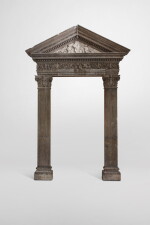
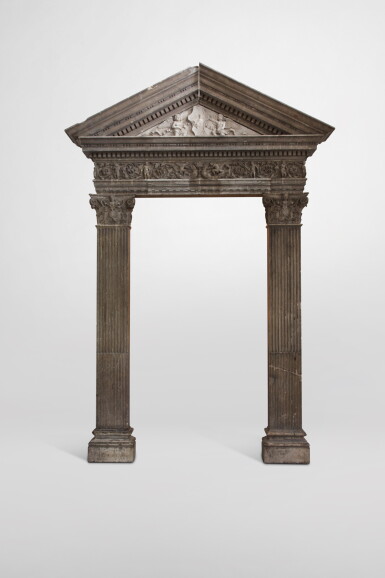
An Italian Limestone Portal Surround with a Tympanum with a Coat of Arms, Possibly Late 15th Century
Estimate
15,000 - 25,000 USD
Lot Details
Description
An Italian Limestone Portal Surround with a Tympanum with a Coat of Arms, Possibly Late 15th Century
inscribed 8/56/0079 in pencil to the base of one of the columns
height 151 ¼ in.; width 94 ⅞ in.; depth: 14 ⅝ in.
384 cm; 241 cm; 37 cm
Palais Bernheimer, Lenbachplatz, Munich;
By descent to Konrad Bernheimer (b.1950) and transferred to Burg Marquartstein, Bavaria in 1987;
The Bernheimer Collection, Sotheby's London, 24 November 2015, lot 12;
Where acquired by the present collector.
This impressive portal previously stood in a courtyard of Bernheimer Palais, a neo-Baroque city palace built in central Munich in 1888/89 by Friedrich von Thiersch for Lehmann Bernheimer (1841-1918), who founded a textile and luxury goods firm that supplied the Bavarian Royal Household and later expanded his business to include antique carpets, furniture, paintings and sculpture, becoming one of the most important European art dealers of the period. After his death the company was run by his son Otto (1877-1960), who became honorary consul of Mexico, until 1938 when the building and its stock were confiscated by the Nazi government, and the Bernheimer family was interned at Dachau and subsequently exiled to Venezuela during the war years. In 1948 the Bernheimer Palais was restituted to the Bernheimer family who resumed trading in antiques and furnishing fabrics, and their specialist focus gradually shifted to Old Master Paintings, particularly when the company was taken over in 1977 by Otto's grandson Konrad (b. 1950), who sold the building in 1987 and transferred much of the stock to the 11th-century castle Burg Marquartstein near the Chiemsee southeast of Munich, where this portal formed the focal point of the Great Gallery.
Based on an architectural form dating to Antiquity, portal surrounds formed by a pair of flanking columns surmounted by pediment with a decorated tympanum were revived by Italian Renaissance architects and placed externally and internally in both ecclesiastic and secular settings to surround doorways, windows, sculpture niches and small alcoves. Surviving examples removed from their original contexts include the richly decorated door surround from the Palazzo Ducale in Gubbio now in the Victoria & Albert Museum, London (accession no. 102-1886), carved from a Tuscan grey sandstone known as pietra serena used widely for architectural construction in Florence and Central Italy. The Bernheimer portal is made of limestone, a material more commonly utilised in Lombardy and Northern Italy, and comparisons have been drawn between its arabesque frieze and capitals and those found on the facade and some interior niches of the late 15th-century church of Santa Maria dei Miracoli in Brescia, particularly in the less naturalistic and more voluminously angular treatment of the putti. The absence of any provenance information prior to the portal's acquisition for the Bernheimer Palais however renders identification of a specific geographic origin of the work difficult.
The lack of documentation also makes it impossible to date the Bernheimer Portal with precision, as some decorative elements such as the female masks and helmets in the capitals appear less consistent with late quattro- and cinquecento models, and it is possible this surround dates at least in part to the 19th century, when numerous Northern European collectors were actively seeking classical architectural elements in the aim of recreating Italian Renaissance interiors or antique Roman lapidaria for both aesthetic and didactic purposes, and numerous copies or pastiches were acquired, often intentionally in order to complete an unfinished space. The high quality of the design and execution of the ornamental decoration of the present lot would nonetheless suggest that if it were completed at a later date, the artist most likely had access to and was working after original Renaissance prototypes.
You May Also Like