A Roman Bronze Balsamarium, circa mid 2nd Century A.D.
Estimate
50,000 - 70,000 USD
Lot Details
Description
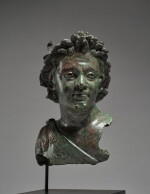
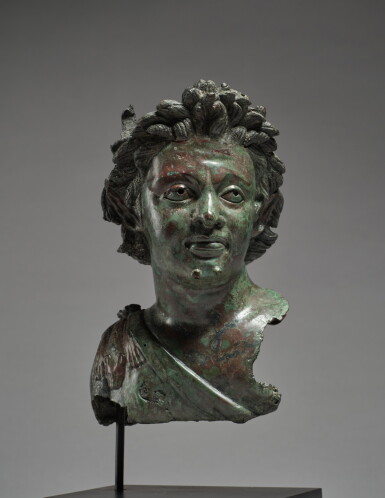
A Roman Bronze Balsamarium, circa mid 2nd Century A.D.
in the form of the bust of a young satyr, his head turned to the left, a panther-skin chlamys fastened with a fibula falling from his right shoulder, his individualized face with serene and slightly sleepy expression, twin round protrusions on the chin, outlined lips formerly copper overlaid, wide slightly upturned nose, large eyes with recessed pupils probably originally overlaid in silver, and furrowed brow, his unruly hair radiating in engraved tussled locks around the face and behind his pointed ears.
bronze
7⅝ in.
19.4 cm
Brummer Gallery, New York, inv. no. P348, acquired from "Meyer, Versailles" on July 1st, 1922 (https://libmma.contentdm.oclc.org/digital/collection/p16028coll9/id/62587/rec/7);
H. Khan Monif, New York, acquired from the above on June 29th, 1948;
Brummer Gallery New York, reacquired at an unknown date, probably from the above;
Ella Baché Brummer (Gallerie Koller and Spink & Son, Zurich, The Ernest Brummer Collection, October 16th-19th, 1979, lot 577, illus.);
William Herbert Hunt Collection (Sotheby's, New York, The Nelson Bunker Hunt Collection. Highly Important Greek Vases. The William Herbert Hunt Collection, Highly Important Roman and Etruscan Bronzes, June 19th, 1990, lot 43, illus.);
American private collection;
Kallos Gallery, London;
Where acquired by the present collector on November 30th, 2016.
Fort Worth, Kimbell Art Museum, Wealth of the Ancient World. The Nelson Bunker Hunt and William Herbert Hunt Collections, June 25th-September 18th, 1983;
Virginia Museum of Fine Arts, October 19th-December 11th, 1983;
Detroit Institute of Arts, February 1st-March 24th, 1984;
Dallas Museum of Art, April 25th-June 10th, 1984;
Atlanta, High Museum of Art, December 10th - February 9th, 1986
The Ernest Brummer Collection. Ancient Art, vol. 2, Gallerie Koller and Spink & Son, Zurich, 1979, no. 577;
Dietrich von Bothmer, Jane M. Cody, Jiri Frel, Arthur Houghton, Catherine Custus Lorber, and Margaret Ellen Mayo, Wealth of the Ancient World. The Nelson Bunker Hunt and William Herbert Hunt Collections, exh. cat., Fort Worth, Texas, 1983, no. 51, illus.
This hollow cast bust originally stood on a round stemmed foot and functioned as a balsamarium, a portable vessel designed to contain oil, perfume, spices, or incense. The crown of the head was cast separately as a hinged lid revealing an opening allowing for the contents to be poured in and extracted at will. An ornate swivel handle, originally attached to the rings protruding on either side of the head, would have allowed for lifting and carrying.
Anthropomorphic balsamaria of this type were probably manufactured in Asia Minor and are commonly found in the Eastern and Northern provinces of Roman empire. Few, however, equal the present example in terms of its liveliness of style, refined execution, and sculptural quality. A comparable luxury balsamarium was discovered in modern day Bulgaria in Kyustendil: K. Majewski, "Brazowe balsamaria anthropomorphiczne w Cezarstwie Rzymskim, Archeologia (Warsaw), vol. 14, 1964 (dated 1963), no. 13.
For a thorough discussion of anthropomorphic balsamaria, their production, cosmetic and religious use, contents, typology, and iconography, see V. Marti, "De l'usage des balsamaires anthropomorphes en bronze", Mélanges de l'École française d'Athènes et de Rome, 1996, pp. 979-1000. Most of them are in the shape of Ethiopians. The second largest group consists of Bacchic subjects, such as Dionysos, Silenus, Pan, or young satyrs. A third group comprises a representation of a youth variously identified as an ephebe or a portrait of Antinous.