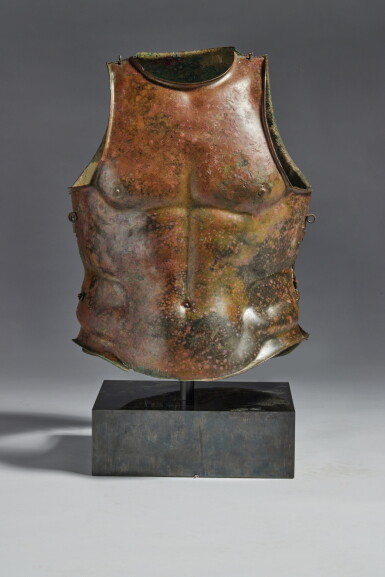
A Greek Bronze Anatomical Cuirass, last Third of the 4th Century B.C./1st Quarter of the 3rd Century B.C.
Estimate
300,000 - 500,000 USD
Lot Details
Description
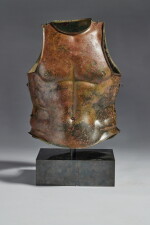
A Greek Bronze Anatomical Cuirass, last Third of the 4th Century B.C./1st Quarter of the 3rd Century B.C.
composed of a front and back plate held together by hinges and by sets of twin attachment rings for leather straps, holes for now lost attachment rings on each shoulder strap, the muscles, spine, and navel clearly indicated, the nipples attached separately, the lower girth increasing to facilitate horseriding.
bronze
height 21 in.
53.3 cm
B. C. Holland/Objects Inc., Chicago, inv. D80-1-14;
Private collection, Chicago, acquired from the above on September 8th, 1980 (Sotheby's, New York, December 6th, 2012, lot 9, illus.);
Where acquired by the present collector.
In the Archaic and Classical periods, warfare in the Greek world was defined by the hoplite, the heavily armed citizen-soldier equipped with a round shield (aspis), spear, and sword. Although the shield and spear formed the essential equipment for phalanx warfare, the ideal hoplite was outfitted with a complete panoply, including a bronze helmet, cuirass, and greaves, reflecting both his military role and social standing. The present cuirass would have been part of one of these full panoplies, completed with an associated helmet and pair of greaves.
Given the considerable value of bronze armour, it was rarely discarded after battle. Pieces were frequently retained for continued use by their original owners or claimed as trophies by the victors. Armour could also assume a votive function, being dedicated in thanksgiving to the gods believed to have secured victory.
The most recent typology of long anatomical cuirasses from Greek colonies in Southern Italy distinguishes between five different types, based on their overall shapes and proportions: R. Graells i Fabregat, "Le corazze nei santuari dell'Italia meridionale", in: R. Graells i Fabregat and F. Longo, eds., Armi votive in Magna Graecia. Atti Convegno Paestum 24-25 Novembre 2017 (RGZM-Tagungen 36), Mainz, 2018, p. 160, fig. 1; the present cuirass matches type 4. The author explains that each plate was hammered while heated, the edges protected by rolling them inwards (pp. 160-161), and that various fixations systems, such as hinges or rings or a combination of both, were used to join the front and back (p. 164, fig. 6). A similar cuirass is in the collection at the Metropolitan Museum of Art, New York (inv. no. 1992.180.3a, b).