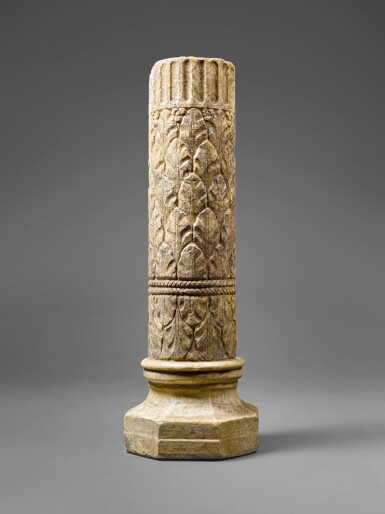
A Roman Foliate Pavonazzetto Marble Column, circa 2nd Century A.D.
Estimate
30,000 - 50,000 USD
Lot Details
Description
A Roman Foliate Pavonazzetto Marble Column, circa 2nd Century A.D.
carved with horizontal echeloned rows of pointed and veined leaves, five rows pointing up above two spiralled fillets, and two rows pointing down below, the top decorated with deep vertical fluting, a square mortise on top of the shaft; on a later Italian white marble octagonal base stenciled in red on one side '12047'.
marble
total height 35½ in.; height without base 32⅛ in.
107 cm; 81.5 cm
Maximilian Graf (Wuppertal, 1892 - Berlin, 1959), Berlin-Schmargendorf, acquired in the 1930s or earlier;
German private collection, Berlin, by descent from the above (Sotheby's, London, June 13th, 2016, lot 69, illus.);
Where acquired by the present collector.
There is a black-and-white print showing the column in Maximilian Graf's house in Berlin, part of a photographic album documenting the entire residence sometime between 1936-1938
Two related white marble columns acquired from Piranesi in the late 18th Century are in the Gustav III Museum of Antiquities in Stockholm, inv. nos. NM SK 277 and 278. A drawing of another related column, once in the Museo Cartaceo of Cassiano dal Pozzo, is now in the British Museum, inv. no. 2005,0927.61. Thomas Hope owned two columns with similar decoration, both after the antique, which he used as pedestals for reproductions of ancient marble vases (see T. Hope, Household furniture & interior decoration, 1807, pl. I [The statue gallery"]; Spink & Son, Ltd., London, An Exhibition of Antique Sculpture, 1986, p. 44, fig. 2, and p. 110, no. 107). For other examples in limestone, many of which are in the Römisch-Germanisches Museum in Cologne, see G. Bauchhenss and P. Noelke, Die Iupitersäulen in den Germanischen Provinzen, 1981.
Maximilian Graf (1892-1959) was the owner a large Aluminium refinery in Berlin before Word War II, the Berliner Aluminium- und Staniol- Fabrik, Fehling & Co., K.-G., Berlin SW29, Hasenheide 9 (or Urbanstr. 64). He was also a collector of Chinese art and European sculpture. The large majority of his art collection, which he kept in his house in Schmargendorf and was later stored in a secure location during the war, was dispersed once the conflict ended. The present column broke in two halves during the Allied bombing of Berlin, when a phosphorus bomb took out a corner of the house. It was then stored in the basement until the family had it repaired and replaced in its original location in the house.
You May Also Like