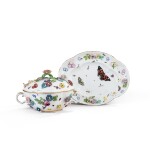
A Meissen porcelain Kakiemon fluted beaker and stand from the Japanese Palace, and a further beaker and stand, circa 1728-30
No reserve
Lot closes
June 25, 11:42 AM GMT
Estimate
4,000 - 6,000 EUR
Current Bid
400 EUR
1 Bid
No reserve
We may charge or debit your saved payment method subject to the terms set out in our Conditions of Business for Buyers.
Read more.Lot Details
Description
each painted with branches of flowering prunus, pomegranate and peonies, the first beaker and stand, crossed swords marks in blue enamel, incised Japanese Palace inventory number N:342-/w, the latter, crossed swords marks in underglaze-blue, all with incised // to inside edge of footrims
(4)
Diameters of stands 6 ⅛ in, 6 in; 15,5 cm, 15,3 cm
One beaker and stand, The Royal Collections of Saxony, Japanese Palace, Dresden;
Both, Scheublein Art & Auktionen, Munich, 27 June 2014, lot 254;
Acquired at the above sale.
Porcelains of this type, largely derived from Japanese Kakiemon prototypes in the Japanese Palace collection of Augustus the Strong and distinguished by crossed swords marks painted in blue enamel rather than underglaze-blue, formed part of a substantial order negotiated around 1729–30 between the director of the Meissen manufactory, Count Hoym, and the Paris marchand-mercier Rudolph Lemaire. The wares were intended for the French market, where they were to be offered as highly sought-after Japanese originals. The enterprise was short-lived: royal suspicion surrounding the arrangement led to Hoym’s fall from favour and subsequent exile, while Lemaire was arrested and ultimately expelled. The porcelains remaining in Hoym’s Dresden residence were confiscated by royal order and absorbed into the Saxon Royal Collection, at which point they were assigned inventory numbers for the Japanese Palace. A comprehensive explanation and discussion of the entire Hoym-Lemaire affair is provided by Julia Weber, in a paper presented at the International Ceramics Fair and Seminar, London, 16 June 2012, 'A detective story: Meissen porcelains copying East Asian models. Fakes or originals in their own right?' and published the following year in the Fair's Catalogue, pp. 41-49.
Beakers and saucers in this pattern are recorded in the Japanese Palace inventories under the numbers 342 and 364. The 1770 inventory lists under number 342: “Sieben und Dreyßig Stück detto [gerippte und gemuschelte Chocolaten-] Becher, mit Blumen gemahlt, 2¾. Zoll tief, 3½. Zoll in Diam: und Eben soviel Unterschaalen, 1¼. Zoll tief, 6½. Zoll in Diam: No. 342 1 Paar Defect”, [thirty-seven ditto (fluted and moulded chocolate) beakers, painted with flowers...] (quoted from Claus Boltz, ‘Japanisches Palais-Inventar 1770 und Turmzimmer-Inventar 1769’, Keramos, 153, 1996, p. 57).
A saucer bearing the Japanese Palace number N=342w was sold at Sotheby’s, London, 17 June 1975 (lot 182), while another example from the Property of The Byrnes Children Trust was sold at Christie’s, London, 12 May 2010 (lot 45). A beaker and saucer marked N=364 were presented by Queen Victoria to the South Kensington Museum (now the Victoria & Albert Museum), London, in 1860 (acc. no. 7328&A-1860), where a further beaker and saucer with N=342W is also preserved (acc. no. C.575&A-1922).
You May Also Like