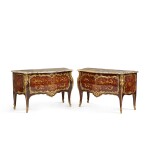
An Italian gilt-bronze mounted parcel-gilt and polychrome painted demi-lune commode, Piedmont, last quarter of the 18th century, the decoration attributed to Angelo Vacca
Lot closes
June 25, 09:37 AM GMT
Estimate
8,000 - 12,000 EUR
Starting Bid
7,000 EUR
We may charge or debit your saved payment method subject to the terms set out in our Conditions of Business for Buyers.
Read more.Lot Details
Description
opening with three drawers and shelves on both sides, decorated with polychrome flowers, with a bleu Turquin marble top
Haut. 91,5 cm, larg. 182 cm, prof. 70 cm ; Height. 36 in, width. 71 2/3 in, depth. 27 1/2 in
Pietro Accorsi, Turin;
Arredi, Dipinti e Oggetti d'Arte dalle Collezioni di Giulio Ometto, Sotheby's, Milan, 11 April 2002, lot 360;
Sotheby's New York, 9 June 2014, lot 251 (sold 46 875 $)
M. Rosci and E. Castelnuovo, Cultura figurativa e architettonica negli Stati del Re di Sardegna, 1773-1861, Torino, 1980, p. 118, n. 121
R. Antonetto, Il Mobile Piemontese nel Settecento, Vol. II, Turin, 2010, p. 63, fig. 45
The demi-lune shape of this commode was particularly popular in Piedmont at the end of the 18th century, often richly decorated with marquetry or paintings, such as the commodes by Bartolomeo Manghetti, at Masimo Castle, in the Viceroy's room, painted in imitation of French marquetry and illustrated in R. Antonetto, Il Mobile Piemontese nel Settecento, Vol. II, Turin, 2010, p. 61, fig. 40. This characteristic shape reflects the French inspiration and the taste of the Savoy court in Piedmont by cabinetmakers such as Giuseppe Viglione or Ignazio and Luigi Ravelli.
Angelo Vacca (1746-1814) was a painter at the Piedmontese court, best known for his mural decorations, notably at the Stupinigi hunting lodge in Venaria, the Rivoli castle, and the Royal Palace of Turin, often featuring rich floral compositions. He is credited with the paintings on several pieces of furniture, including a lacquered commode in the Palazzo Falletti di Barolo, Turin, in a similar style, (op.cit p. 63, fig. 43), as well as a half-moon commode in the Accorsi-Ometto Museum of Decorative Arts in Turin (Inv. no. M575).
You May Also Like