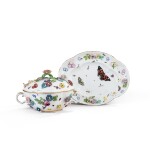
A Meissen porcelain Kakiemon 'Gelber Löwe' pattern plate and a large dish, circa 1729-31 and 1735
No reserve
Lot closes
June 25, 11:47 AM GMT
Estimate
2,000 - 3,000 EUR
Starting Bid
50 EUR
We may charge or debit your saved payment method subject to the terms set out in our Conditions of Business for Buyers.
Read more.Lot Details
Description
each painted in Kakiemon style with a tiger curling around bamboo facing flowering prunus branches issuing from a tree-stump, their eyes picked out in gilding, brown-edged rims, the plate with crossed swords mark in blue enamel, the dish with crossed swords mark in underglaze-blue, Dreher’s mark to inside edge of footrim
(2)
Diameter of plate 9 in; 22,8 cm
Diameter of dish 13 ⅜ in; 34 cm
Porcelains of this type, largely derived from Japanese Kakiemon prototypes in the Japanese Palace collection of Augustus the Strong and distinguished by crossed swords marks painted in blue enamel rather than underglaze-blue, formed part of a substantial order negotiated around 1729–30 between the director of the Meissen manufactory, Count Hoym, and the Paris marchand-mercier Rudolph Lemaire. The wares were intended for the French market, where they were to be offered as highly sought-after Japanese originals. The enterprise was short-lived: royal suspicion surrounding the arrangement led to Hoym’s fall from favour and subsequent exile, while Lemaire was arrested and ultimately expelled. The porcelains remaining in Hoym’s Dresden residence were confiscated by royal order and absorbed into the Saxon Royal Collection, at which point they were assigned inventory numbers for the Japanese Palace. A comprehensive explanation and discussion of the entire Hoym-Lemaire affair is provided by Julia Weber, in a paper presented at the International Ceramics Fair and Seminar, London, 16 June 2012, 'A detective story: Meissen porcelains copying East Asian models. Fakes or originals in their own right?' and published the following year in the Fair's Catalogue, pp. 41-49.
You May Also Like