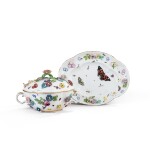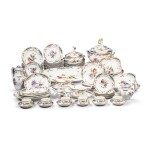

A large Berlin (K.P.M.) porcelain 'Breslauer Stadtschloss'-pattern part-dinner service, 20th century
Live auction begins on:
June 24, 12:30 PM GMT
Estimate
6,000 - 10,000 EUR
Lot Details
Description
painted with large flower sprays within fluted borders moulded and gilt with trailing blooms and rocailles enclosing blue-scale-pattern sections, within moulded ribbon-tied reeded rims, comprising:
1 large two-handled circular tureen and cover, width across handles 14 1/8 in; 36 cm; 2 smaller circular tureens and covers, width 10 1/4; in; 26 cm; 1 large over fish dish, width 25 in; 63,5 cm; 1 large oval platter, width 19 ¾ in; 50 cm; 1 oval platter, width 16 ⅛ in; 41 cm; 2 oval platters, width 12 ¼ in; 31 cm; 2 oval bowls, width 10 ½ in; 26,5 cm; 2 square bowls, width 9 in; 23 cm; 2 square stands, width 9 ¾ in; 24,5 cm; 2 double-lipped sauceboats on fixed stands; 12 dinner plates, diam. 9 ⅞ in; 25 cm; 12 plates, diam. 8 ⅞ in; 22,5 cm; 12 soup plates, diam. 9 ½ in; 24 cm; 6 side plates, diam. 7 ⅞ in; 20 cm; 12 bread and butter plates, diam. 7 ⅛ in; 18 cm; 1 large coffee pot and cover; 1 teapot and cover; 1 sugar bowl and cover; 1 milk jug; 6 cups and saucers,
together with a German porcelain serving ladle,
sceptre marks in underglaze-blue, printed orb over KPM marks, various impressed marks, various painter’s marks
(93)
Anonymous sale, Van Ham, Berlin, 17 May 2023, lot 1007;
Acquired at the above sale.
As the Berlin manufactory’s principal patron, Frederick the Great integrated porcelain into a broader decorative program in which table services functioned as extensions of architecture and interior design. The original service in this pattern, commissioned in 1767 for the Wrocław City Palace, exemplifies this approach, and at a price of 7,040 thaler was the most expensive service commissioned by Frederick. Its “Antique” forms reflect an early Neoclassical turn in its structured contours, while retaining the Rococo through blue scale reserves, gilding, and vegetal ornament. Frederick the Great likely inherited his taste for porcelain from his mother, Sophie Dorothea of Hanover, whose cultivated court at Monbijou Palace. There, music, collecting, and display—particularly of porcelain—formed part of a refined visual and intellectual milieu that shaped Frederick’s identity as an Enlightenment patron.
You May Also Like