
Property from the Collection of David H. Murdock
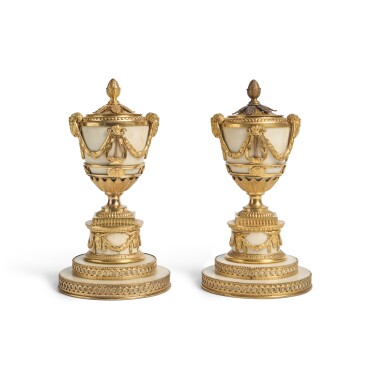
A Pair of George III White Marble and Gilt Bronze Lyre Vases by Matthew Boulton, Circa 1772
Lot closes
April 14, 04:25 PM GMT
Estimate
30,000 - 50,000 USD
Starting Bid
18,000 USD
We may charge or debit your saved payment method subject to the terms set out in our Conditions of Business for Buyers.
Read more.Lot Details
Description
the pierced leaf-tip lids with pinecone finials above ovoid white marble bodies mounted with ram's heads and lyres joined by laurel garlands and supported by leaf-tip turned and gadrooned socles raised on a stepped circular base with bucrania and pierced guilloche borders
height 11 3/4 in.; diameter of base 5 3/4 in.
31.5 cm; 14 1/2 cm
Mr and Mrs Robert Tritton, Godmersham Park, Kent;
Christie's on the Premises, Godmersham Park, Kent, 6-9 June 1983, lot 97.
Michael M. Thomas, 'Bellagio House. The David Murdock Estate in Bel-Air', Architectural Digest, February 1987, p.58
Nicolas Goodison, Matthew Boulton: Ormolu, London 2002, p.343 fig. 347
Intended to be used as incense or perfume burners, a 'small lyre vase' is listed in Boulton's Day Book in 1780, and a 'lyre essence vase, white marble in parts broken' was recorded in Boulton's stock inventory in 1782 (Goodison 2002, p.342). The antique motifs such as bucrania, ram's heads and Grecian lyres reveal the possible influence of the neoclassical architect Sir William Chambers or the Danish-born bronze worker Diederich Nicolaus Anderson (d. 1767), who executed works after designs by among others Chambers and the architect James 'Athenian' Stuart.
Several examples of lyre vases in white marble have survived, including a pair from the collection of Lady Samuel of Wych Cross, sold Sotheby's London, 18 November 2008, lot 77 (76,850 GBP), and a pair sold Christie's New York, 17 October 1997, lot 218 ($134,500) and now in a private collection (illustrated Nicholas Goodison, Ormolu: The Work of Matthew Boulton, London 1974, fig. 117). Versions of this model in Blue John are more rare and include a pair from the personal collection of Sir Nicholas Goodison and illustrated in his 2002 study on Boulton, p.343 fig.346.
The silversmith, industrialist and entrepreneur Matthew Boulton (1728-1802) was one of the most important figures in 18th-century English decorative arts, of comparable stature and influence to Thomas Chippendale in furniture and Josiah Wedgwood in ceramics. In 1762 he entered into partnership with John Fothergill and quickly transformed his father’s metalworks in Soho, Birmingham, into the largest factory of silver, ormolu and ormolu-mounted objects in the world, employing almost 800 workers at its peak in the 1770s. A pioneer of proactive marketing, Boulton held four sales of his work at Christie’s in 1770, 1771, 1772 and 1778, and his clientele included both the British gentry and overseas patrons, notably Catherine the Great of Russia.
Godmersham Park is a two-story Palladian house in the North Downs between Kent and Ashford built in 1732 for the Kent landowner and Tory MP Thomas Knight (c.1701-1781). In 1794 it was inherited by Edward Austen (1767-1852), elder brother of the novelist Jane Austen, who visited regularly between 1798 and 1813 and is believed to have based Mansfield Park on Godmersham. Edward Austen's son sold the property in 1874, and it was sold again in 1935 to Robert and Elsie Tritton, who restored the house and filled it with an important collection of furniture and artworks, dispersed after Mrs Tritton's death in 1983 in a landmark three-day house sale widely regarded as one of the most important English furniture auctions of the last quarter of the twentieth century.
You May Also Like


