
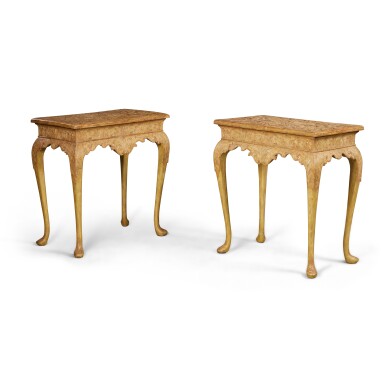
A Pair of George I Giltwood and Gilt Gesso Tables, Circa 1715
Estimate
70,000 - 100,000 USD
We may charge or debit your saved payment method subject to the terms set out in our Conditions of Business for Buyers.
Read more.Lot Details
Description
height 30 in.; width 28 ½ in.; depth 17 in.
76 cm; 72.5 cm; 43 cm
Mallett, London
This type of gilt gesso table appeared the end of the Queen Anne period and early years of George I’s reign and is distinguished by strapwork, foliage and shell relief decoration inspired by the work of the William & Mary’s Huguenot architect Daniel Marot (1661-1752) and based on French designs of the Louis XIV era by artists like Jean Bérain, Jean Le Pautre and André-Charles Boulle. Such tables are often attributed to the court cabinetmaker James Moore senior (1670-1726), who from 1714 in collaboration with the Strand cabinet and glass maker John Gumley (1691-1727) supplied a group of pier tables, mirrors, torcheres and chandeliers in this style to the Royal Household, including a large pier table decorated with George I’s cypher and the Order of the Garter, possibly originally a pair, delivered to Kensington Palace in c.1723 and now in Buckingham Palace (RCIN 596; illustrated in Percy Macquoid and Ralph Edwards, The Dictionary of English Furniture, London 1954 Vol. III p.281 fig. 24).
Moore is also known to have supplied similar work to prominent aristocratic clients including the 1st Duke of Marlborough at Blenheim Palace, the 1st Duke of Montagu and Boughton, and the Duchess of Buccleuch at Dalkeith Palace, and his name has been evoked in connection with a gilt gesso table recorded in 1726 in the Second Best Bedchamber at Erddig, North Wales (illustrated in Adam Bowett, Early Georgian Furniture, Woodbridge 2009, p.210, Plate 5:19), although a similar table in silvered gesso along with other gilt gesso furniture including pier glasses, girandoles and a State Bed was supplied to the house at the same time by the St Paul’s Churchyard, London cabinetmaker John Belchier (1699-1753), whose workshop is particularly associated with gilt gesso mirrors created in this taste.
The form derives from pier tables developed in the seventeenth century as part of a ‘triad’ of a dressing table with a looking glass above and flanked by a pair of torcheres and by the early eighteenth century had evolved into an independent large console or side table and smaller individual tables that may have served in bedchambers and dressing rooms. Surviving pairs of this type of table are relatively rare and include a pair greater width previously in the collection of Barbara ‘Bobo’ Rockefeller, New York, sold Sotheby’s London, 6 December 2023, lot 15 (88,900 GBP), a further example with the Sandys family at Ombersley Court, Worcestershire, sold Christie’s London, 29 November 2023, lot 45 (56,700 GBP), and another pair from the Duarte Pinto Coelho Collection sold Christie’s South Kensington, 21 July 2011, lot 111 (121,250 GBP). Pairs of gilt gesso tables of comparable smaller scale to the present lot include a pair formerly at Fonmon Castle, Glamorgan sold Sotheby’s London 17 January 2024, lot 100 (76,200 GBP) and a pair from the collection of Mrs Diane Gubbay sold Christie’s New York, 15 April 2011, lot 550 ($80,500; one illustrated in Geoffrey Beard and Judith Goodison, English Furniture 1500-1840, Oxford 1987, p.53 fig. 6), and a single example of similar scale was recently sold from the Ann and Gordon Getty Collection, Christie’s New York, 23 October 2022, lot 537 ($94,500).
You May Also Like


