
Property from the Collection of David H. Murdock
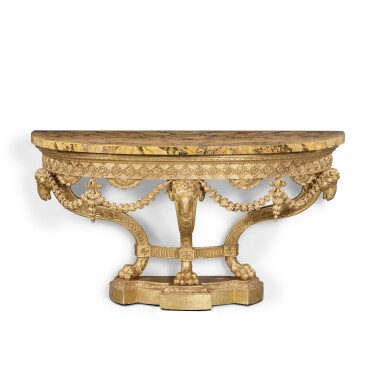
A George III Carved and Giltwood and Gilt Gesso Console Table designed by Robert Adam and made by William France and John Bradburn, 1765
Estimate
100,000 - 150,000 USD
We may charge or debit your saved payment method subject to the terms set out in our Conditions of Business for Buyers.
Read more.Lot Details
Description
of D-shaped form with later Siena marble top; the guilloche and rosette frieze with four half-rosettes suspended along lower edge; above three scrolling anthemion-carved legs headed by ram's heads and terminating in paw feet, joined by husk swags and a fluted stretcher, raised on a stepped moulded base with anthemion border; previously with additional swags around the rams' heads; re-gilt
height 35 1/2 in.; width 66 in.; depth 29 1/2 in.
90 in.; 167.5 cm; 75 cm
Supplied to Sir Lawrence Dundas, Bt in 1765, either for 19 Arlington Street, St James's London or for Moor Park, Hertfordshire, and transferred to 19 Arlington Street after the sale of Moor Park in 1784;
Thence by descent at 19 Arlington Street to Lawrence John Lumley Dundas, 2nd Marquess of Zetland (1876-1961);
Christie's London, 26 April 1934, lot 77 (as one of a pair);
Probably William Randolph Hearst (1863-1951);
Property of a Lady, Christie's New York, 28 March 1981, lot 213.
Arthur T. Bolton, 'Some Early Adam Furniture at No. 19 Arlington Street', Country Life, 24 September 1921, p.386
Arthur T. Bolton, The Architecture of Robert and James Adam, 1758-1794, London 1922, Vol. II, p. 291
Percy Macquoid and Ralph Edwards, The Dictionary of English Furniture, London 1927, Vol. III, p. 270, fig. 51
Geoffrey Beard and Judith Goodison, English Furniture 1500-1840, London 1987, p.166 fig. 2
Eileen Harris, The Genius of Robert Adam. His Interiors, New Haven and London 2001, p.118 fig. 176
A SCOTTISH TYCOON OF THE GEORGIAN ERA, KNOWN AS 'THE NABOB OF THE NORTH'
Sir Lawrence Dundas, 1st Baronet (1712-1781) epitomised the new generation of preeminent self-made connoisseurs and collectors who emerged during the third quarter of the eighteenth century with the vast expansion of wealth created through the continuing development of Britain's global overseas empire and increased mercantile activity both during and following the conclusion of the Seven Year's War (1756-1763). He was described by James Boswell in equal measure as 'a comely jovial Scottish gentleman of good address but not bright parts' and 'a cunning shrewd man of the world'. The son of an Edinburgh draper, Dundas started as a successful wine merchant who subsequently made a fortune as a supplier to the British Army and then expanded his activities to financial speculation and land ownership, becoming one of the wealthiest men of his era. In the early 1760s he acquired three significant properties in England: the Jacobean and Georgian house Aske Hall near Richmond, North Yorkshire and the neo-Palladian Moor Park in Hertfordshire, built for the Duke of Monmouth in the 1670s and remodelled by the architect Giacomo Leoni in the 1720s, and both country houses with parkland designed by Capability Brown; and finally a London townhouse at 19 Arlington Street, St James's.
Dundas undertook comprehensive refurbishments of his newly acquired dwellings at a time when London was one of the most important and active design centres in Europe, and his wealth allowed him to patronise the leading cabinetmakers and upholsters of his day, among them Samuel Norman, William Vile and John Cobb, James Lawson, William France and John Bradburn, Pierre Langlois, William Ince and John Mayhew, and unsurprisingly Thomas Chippendale, all of whom supplied furniture to Dundas during the 1760s. Dundas's innovative spirit also drew him to the nascent neoclassical style of the third quarter of the eighteenth century developed by a rising generation of architects including James 'Athenian' Stuart, William Chambers and above all Robert Adam (1728-1792), the Scottish-born architect who established a practice in London in 1758 following a four year Grand Tour to Rome, and in 1761 was appointed an architect of the King's Works. When Adam was commissioned by Dundas to work on his London townhouse he had already embarked upon or completed several projects for prestigious and aristocratic country seats including Kedleston Hall, Shardeloes, Osterley Park, Harewood House and Syon House.
AN ICONIC ROBERT ADAM COMMISSION
The offered lot formed part of one of the most celebrated interiors in Georgian England and is the second of two tables of nearly identical design designed by Robert Adam in 1764/65, the first differing in its use of a Vitruvian Scroll motif on the frieze and stretcher rather than the guilloche and fluting (sold Christie's London, 5 July 2012, lot 17, £193,250), and more recently on the London market with Ronald Phillips Ltd). A finished drawing of the this table, dated 1765 and possibly annotated by Adam himself, survives in the Soane Museum London (SM Adam Volume 175), described as a 'Table frame for Sir Laurence Dundas Baronet' and 'Arlington Street. A Table frame for Long Room next to the Eating Parlour'. An invoice survives in the Zetland archives from the rising London cabinetmakers William France and John Bradburn, both former journeymen in William Vile's workshop who had taken over the Royal Warrant as official cabinetmakers to George III and Queen Charlotte following Vile's retirement in 1764. Dated 12 January 1765, the invoice charged Dundas 15 guineas for 'a Circular Frame, for a Marble Table, richly carv'd with ramsheads at Top, & Husks falling down the 3 Shaped Legs & gilt in burnished gold and putting up the above'. On 30 December 1795, France and Bradburn invoiced a second 'circular Frame for a Marble Table, Richly Carved with Rams heads, & husks falling, as the one in the Blue drawing Room, & putting up Do., Screws, etc...' (bills reproduced in Anthony Coleridge, 'Dundas and some Rococo Cabinet-Makers', Apollo, September 1967, p.214-215).
Unlike the annotated drawing and first invoice, the latter document does not specify a location for the second table, and Eileen Harris has suggested it may have been sent to Moor Park, just outside of London. Almost identical highly sculptural ram's heads and a guilloche and rosette frieze were also utilised by Adam in his designs for a suite of seat furniture designed the previous year for the Banqueting Hall at Moor Park; this comprised six armchairs, two sofas and two stools produced by the Covent Garden cabinetmaker James Lawson (fl.1763-1778) and were invoiced on 26 October 1764. Part of this set is now at Kenwood House, Hampstead, London, and a pair of armchairs from the suite was sold Christie's London, 18 June 2008, lot 9. In the interest of stylistic unity, the resolutely neoclassical ornamental repertory of both the Moor Park suite and the two console tables was also paralleled by the acanthus scrolls, anthemia, sphinxes and paw feet incorporated into Robert Adams's concurrent designs for what was Dundas's most expensive commission for his new interiors - and arguably the most important commission of neoclassical furniture in 18th century England - the set of eight armchairs and four sofas made by Thomas Chippendale for the Great Room at 19 Arlington Street in 1765, the only documented example of a collaboration between the two titans of English architecture and furniture design. One armchair from the suite is now in the Victoria & Albert Museum, London, and one sofa is in the Museum of Fine Arts, Houston; three armchairs and one sofa from the group were most recently in the Al Thani Collection at the Hôtel Lambert, Paris, sold Sotheby's Paris, 11 October 2022, lots 56-58.
Following Dundas's death in 1781, his estates were inherited by his son Thomas Laurence, 1st Baron Dundas (1741-1820), who sold Moor Park to Thomas Bates Rous, a former director of the East India Company. The house subsequently passed through a succession of owners including Robert Grosvenor, 1st Baron Ebury in the nineteenth century and Lord Leverhulme in the twentieth, and is now a private club and golf course. Much of the original furniture was transferred to other Dundas properties at the time of sale, so the if this console had been at Moor Park in the eighteenth century it would have arrived in London at this time and remained by descent at 19 Arlington Street into the first decades of the twentieth century, where it was photographed in situ in 1921. In 1933 the house was sold to be demolished for the construction of an Art Deco block of flats, and the two console tables were sold as a matched pair at Christie's in 1934, where they were acquired by Permain, believed to be an agent acting for the American media mogul William Randolph Hearst, who was actively buying in the London art trade at the time to furnish residences in Wales and San Simeon, California. The precise subsequent history of the tables prior to their separate re-appearance on the market is currently unknown.
You May Also Like


