
Beyond the Brushstroke: The Sam and Marilyn Fox Collection
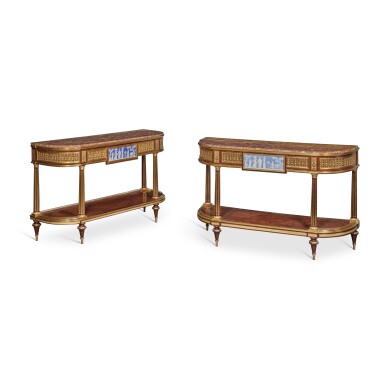
A Matched Pair of Gilt-Bronze Mounted Mahogany, Thuya and Ebony-Inlaid Console Dessertes in the manner of Weisweiler, Probably First Half 19th Century
Estimate
40,000 - 60,000 USD
We may charge or debit your saved payment method subject to the terms set out in our Conditions of Business for Buyers.
Read more.Lot Details
Description
each with a later brocatelle d'Espagne top above a sprung frieze drawer mounted with a Sèvres or Wedgwood japserware plaque depicting a classical Sacrifice scene, flanked by two sprung D-shaped corner drawers and supported by four brass-inlaid fluted columns joined by an undertier raised on toupie feet; partially remounted and adapted to form a pair; slight variations in dimensions, construction and design; one table possibly earlier in date
height 33 1/2 in.; width 54 in.; depth 18 1/4 in.
82.5 cm; 137 cm; 46.5 cm
One table possibly Eugène Kraemer Collection, Galerie Georges Petit, Paris, 28-29 April 1913, lot 170; acquired by E.M. Hodgkins, London;
One table from the collection of Nathaniel Mayer Rothschild, 1st Baron Rothschild and Emma Louise von Rothschild, 148 Piccadilly, London; thence by descent to Victor, 3rd Baron Rothschild, sold Sotheby's, London, 19 April, 1937, lot 183; acquired by the dealer Bensimon, Paris;
Both tables Daisy Fellowes (1890-1962), 69 Rue de Lille, Paris; thence by descent to her daughter Emmeline, Comtesse de Castéja;
Etude Couturier Nicolay, Drouot, Paris, 20 October 1983, lot 78;
Important French Furniture from a Distinguished European Collection, Christie's New York, 20 May 1998, lot 81;
Sam and Marilyn Fox, St Louis, Missouri.
Pierre Arizzoli-Clémentel, Georges Geffroy, 1905-1971 : une légende du grand décor français, Paris 2016, p.73
INNOVATION AND ANGO-FRENCH INFLUENCE IN LATE LOUIS XVI FURNITURE DESIGN
Serving tables with frieze drawers and one or more open shelves known as consoles dessertes became a common form in the 1780s and were produced by many of the leading ébénistes of the late Louis XVI period, among them the German expatriate cabinetmaker Adam Weisweiler (1744-1820, maître 1778). Weisweiler worked for the marchand mercier Dominique Daguerre (d.1796), arguably the most important Parisian luxury goods merchant during the final years of the Ancien Régime who sourced furniture and artworks for wealthy and aristocratic collectors and connoisseurs as well as royal courts both in France and overseas, including the kings of Spain and Naples and the Prince of Wales (later George IV) in England. Through Daguerre, Weisweiler was able to supplant his fellow German-born furniture maker Jean-Henri Riesener as one of the leading suppliers to Louis XVI and Marie-Antoinette after 1785, producing case furniture often decorated with expensive and exotic materials such as gilt bronze, Japanese lacquer, pietre dure hardstones and Wedgwood or Sèvres blue and white jasperware.
The taste for jasperware developed from the technique of mounting furniture with Sèvres porcelain plaques, initiated in the 1760s by Daguerre's predecessor and cousin by marriage Simon-Philippe Poirier (d.1785), who held a monopoly on acquiring plaques for this purpose from the factory and commissioned work from a small group of cabinetmakers including Roger Lacroix and Martin Carlin. Following the Eden Free Trade Agreement between France and England signed in 1786, English style and luxury items became fashionable among prominent French tastemakers, and Daguerre was able to become Wedgwood's exclusive agent in France in 1787. Weisweiler became particularly associated with furniture veneered in tropical woods like mahogany and thuya and mounted with Wedgwood plaques or medallions, such as the tulipwood and citronnier parquetry vide-poche that belonged to Empress Josephine and is now in the Wallace Collection, London [F325], and a guéridon with twelve roundels representing signs of the zodiac set into the top now in the Hermitage, St Petersburg.
A single console desserte attributed to Weisweiler virtually identical to the present pair was sold Christie's New York, 22 May 2002, lot 340, and several D-shaped consoles with a central jasperware plaque and joined by pierced stretchers stamped oy or attributed to Weisweiler are recorded including an amboyna table illustrated in Pierre Kjellberg, Le mobilier français du XVIIIe siècle (Paris 2002), p.911 fig. a; a very similar version in thuya sold Christie's London, 4 December 1975, lot 83, illustrated in Patricia Lemonnier, Weisweiler (Paris 1983), p.118; and a further comparable example in amboyna sold Christie's Paris, 5 May 2011, lot 353. Despite the Revolution, Weisweiler appears to have continued working throughout the 1790s and early years of the 1800s, and it is possible the offered lot emanates from his workshop, or it may have been created by a later imitator during the Restauration and Louis-Phillipe period when porcelain-mounted furniture in the Louis XVI style returned to fashion, particularly among English collectors.
A SERIES OF DISTINGUISHED TWENTIETH-CENTURY INTERIORS
The two tables do not appear to have been created originally together as a pair. One may possibly be identified with a table from the collection of the 19th-century Paris art dealer and connoisseur Eugène Kraemer, who was also an advisor to the Rothschild family in France. The auction catalogue of his collection sold following his death in 1913 describes a similar table but with a white marble top and mirrored back, and it was acquired by the London antique dealer Edward Marriott Hodgkins. One table also seems to correspond with a console from the collection of Nathaniel Mayer Rothschild, 1st Baron Rothschild (1840-1915) and his wife Emma Louise von Rothschild (1844-1935) in their London townhouse at 148 Piccadilly; this was possibly inherited with the house from Nathaniel's father Baron Lionel de Rothschild (1808-1879), who had acquired the property in 1844. Shortly after Emma's death 148 Piccadilly passed to her great nephew Victor, 3rd Baron Rothschild (1910-1990), who sold the house and its contents in 1937, and in the auction catalogue it appears in a photograph of Lady Rothschild's Boudoir with a white marble top.
At some point thereafter the two tables were adapted to form a pair with matching brocatelle marble tops and were acquired by the writer, socialite and style icon Daisy Fellowes (née Marguerite Séverine Philippine Decazes de Glücksbierg 1890-1962), whom contemporary observers described as 'born too late for Proust and too early for Visconti'. Daughter of the 3rd Duke Decazes and the American Isabelle-Blanche Singer (1869–1896), heiress to the Singer sewing machine fortune, Daisy was raised by her maternal aunt Winnaretta Singer, Princesse de Polignac, and in 1910 married Jean Amédée Marie Anatole de Broglie, Prince de Broglie, with whom she had three daughters. Following his death in World War I she remarried in 1919 the Hon. Reginald Ailwyn Fellowes (1884–1953), son of William Henry Fellowes, 2nd Baron de Ramsey and a cousin of Winston Churchill, reputedly after a failed attempt to seduce Churchill himself; the couple had one daughter. Fellowes maintained residences in Paris, London, Oxfordshire and the French Riviera and entertained regularly, receiving members of the international glitterati including Duff Cooper, Alexis de Redé, Juan de Bestegui and the Duke and Duchess of Windsor. From a young age she was regarded as a great beauty, with her portrait sketched by John Singer Sargent and photographed among others by Man Ray and Cecil Beaton, who described her as 'spoilt, capricious and wicked'. She wrote several minor novels and worked as the Paris editor of Harper's Bazaar, appearing frequently on the world's best-dressed lists, and she was a major patron of the fashion designer Elsa Schiaparelli and the jeweller Cartier, particularly fond of the house's tutti frutti creations. Diana Vreeland wrote that she possessed 'the elegance of the damned'.
The consoles stood in the dining room of Fellowes's Parisian apartment at 69 Rue de Lille in Paris, opposite the Musée d'Orsay, that was decorated by the legendary French postwar designer Georges Geffroy, whose clients included Gloria Guinness, Artur Lopez de Willshaw and the Baron de Redé. Fittingly, the tables would later enter the collection of the St. Louis, Missouri philanthropists Sam and Marilyn Fox, whose interiors were originally created by another iconic 20th Century designer, Jed Johnson (1948-1996). Partner of the artist Andy Warhol for twelve years, Johnson began his design career by decorating the Manhattan townhouse he shared with Warhol between 1974 and 1980, subsequently completing projects for Pierre Bergé, Mick Jagger and Jerry Hall, Peter and Sandy Brandt, Barbra Streisand and Richard Gere, before his tragic premature death in a plane crash in 1996.


