
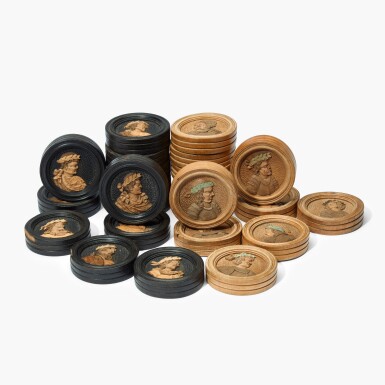
From the chess collection of Lothar Schmid
Gaming Counters | A group of twenty-four counters, Eger, mid-17th century
No reserve
Estimate
3,000 - 5,000 GBP
We may charge or debit your saved payment method subject to the terms set out in our Conditions of Business for Buyers.
Read more.Lot Details
Description
Gaming counters
A group of twenty-four Bohemian relief-impressed maple and ebonized gaming counters (spielmarken), Eger, mid-17th century
including two sets each of twelve pieces, each with a portrait in profile, 6.4cm diameter
In the courts and elite households of Renaissance Europe, games of skill such as backgammon, trictrac, chess, and draughts formed an important part of aristocratic leisure culture. Mastery of these games was regarded as a marker of refinement, but even more significant was the possession of finely crafted gaming equipment. As gaming grew in popularity across the sixteenth century, so too did the demand for exquisitely made boards and counters, a demand met above all in the renowned southern German centres of Augsburg and Nuremberg and in neighbouring Bohemia.
It is within this context that sets of portrait counters such as the present example were produced in series and frequently drew on the imagery of contemporary medals. Portraits of prominent rulers — such as Charles V or Ferdinand I — regularly appear on surviving examples.
The counters were not only decorative but also functional. Each game required two sets, differentiated by the contrasting colours of the woods employed. The subtle difference between the lighter wood upper section and the darker stained turned base would have been more pronounced when newly made and probably served to distinguish opposing players, with the woods reversed on the companion set. The high turned wooden rim also served a practical purpose, protecting the delicate portrait medallion during play.
Their manufacture demanded the collaboration of at least two specialised craftsmen. A turner first shaped the base, softening the wood by steaming so that it could be finely worked on the lathe. A separate craftsman then carved the portrait, and glued it on the wooden mount. By the mid-sixteenth century, technological developments had introduced an alternative method: portraits and ornamental motifs could be relief-impressed using moulds and metal dies.
A comparable backgammon draught made in Eger is in the collections of Birmingham Museum & Art Gallery, inv. nr. 1965T6072.6. A group of counters made in Eger and from the E.W. Pasold Collection is illustrated in Heribert Sturm, Egerer Reliefintarsien, 1961, p.113, fig.3 and p.241, fig.97. Gaming equipment from boards to counters is further discussed in the same book pp.204–236.
You May Also Like


