
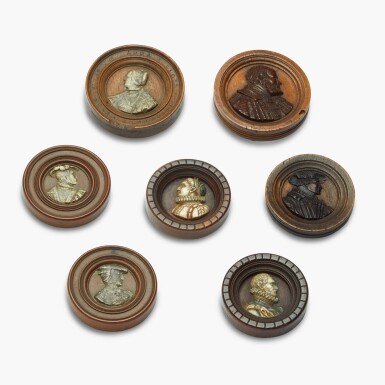
From the chess collection of Lothar Schmid
Gaming Counters | A group of seven counters, southern Germany, mid-16th century
No reserve
Estimate
5,000 - 7,000 GBP
We may charge or debit your saved payment method subject to the terms set out in our Conditions of Business for Buyers.
Read more.Lot Details
Description
Gaming counters
A group of seven South German wood and gesso gaming counters (spielmarken), mid-16th century, comprising:
(i) one gesso portrait of an Empress on a maple frame, marked ANNA REGIS FERDINANT I VXOR, numbered '12792' to the back, 5.2 cm diameter
(ii) and (iii) two gesso portraits of a male figure on a maple frame, one numbered '9695' and the other '9694' to the back, each 4.4cm diameter
(iv) and (v) two polychrome gesso portrait, one of a male figure, the other of a female figure, on an ebonized wood frame, each 4.4cm diameter
(vi) one maple and ebonized wood portrait of a male figure, 5cm diameter
(vii) one stained and ebonized wood portrait of a male figure, 4.5cm diameter
In the courts and elite households of Renaissance Europe, games of skill such as backgammon, trictrac, chess, and draughts formed an important part of aristocratic leisure culture. Mastery of these games was regarded as a marker of refinement, but even more significant was the possession of finely crafted gaming equipment. As gaming grew in popularity across the sixteenth century, so too did the demand for exquisitely made boards and counters, a demand met above all in the renowned southern German centres of Augsburg and Nuremberg and in neighbouring Bohemia.
It is within this context that sets of portrait counters such as the present example were produced in series and frequently drew on the imagery of contemporary medals. Portraits of prominent rulers — such as Charles V or Ferdinand I — regularly appear on surviving examples.
Their manufacture demanded the collaboration of at least two specialised craftsmen. A turner first shaped the base, softening the wood by steaming so that it could be finely worked on the lathe. A separate craftsman then carved the portrait, and glued it on the wooden mount. By the mid-sixteenth century, technological developments had introduced an alternative method: portraits and ornamental motifs could be relief-impressed using moulds and metal dies.
Several games pieces are held in the collections of the Victoria & Albert Museum in London (see the portrait of Charles V, inv. A.513-1910; the portrait of Conrad Peutinger of Augsburg, inv. A.519-1910; the portrait of Margarete von Frundsberg, inv. A.515-1910, or the portrait of Christina, Duchess of Saxony, inv. A.520-1910) and of the Metropolitan Museum of Art in New York (see the portrait of Sybille of Saxony, inv. 2023.364.1).
The Bavarian National Museum in Munich also holds a large collection of German games counters (see Himmelheber, op.cit., 1972, pp.60-71).
LITERATURE:
G. Himmelheber, Spiele. Gesellschaftsspiele aus einem Jahrtausend, cat. Bayerischen Nationalmuseum, Munich, 1972; Spielwelten der Kunst -- Kuntskammerspiel, Kunsthistoriches Museum Wien, Exhibition Catalogue, 1998


