
Property from the Collection of David H. Murdock
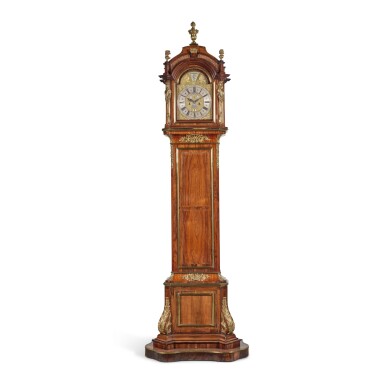
A George II Gilt-Bronze Mounted Padouk Longcase Clock, Circa 1750
Lot closes
April 14, 03:28 PM GMT
Estimate
40,000 - 60,000 USD
Starting Bid
25,000 USD
We may charge or debit your saved payment method subject to the terms set out in our Conditions of Business for Buyers.
Read more.Lot Details
Description
the associated movement of c.1725 signed Stephen Pyke; the 11 1/2 in. dial with silvered chapter ring incorporating subsidiary seconds dial, calendar aperture and signature cartouche, and with female mask and scroll spandrels and calendar with month and day in the arch, the movement of eight-day duration striking hours on a bell; the arched hood with three vase and flower finial and pierced fretwork above the dial with canted corners mounted with scrolling female herms; the brass-inlaid trunk and plinth with gilt brass borders and gilt bronze floral, shell and acanthus mounts; on a moulded stepped base; with a later separate serpentine brass-mounted burr wood plinth
height 107 1/2 in.; width 29 1/2 in.; depth 14 in
273 cm; 75 cm; 35.5 cm
height of later plinth 3 1/2 in.; width 34 1/2 in.; depth 16 1/2 in.
9 cm; 87.5 cm; 42 cm
Ronald Lee, London;
Mr and Mrs Saul P. Steinberg New York;
Sotheby's New York, 26 May 2000, lot 210 ($269,750).
Very little is known about the life and work of Stephen Pyke, but it is conceivable that he was related to the London clockmaker John Pyke (d.1762), who was admitted to the Freedom of the Clockmakers' Company in 1720 and recorded as active in Bedford Row, and his son George, who was appointed clockmaker and organ builder to the Prince of Wales. Both father and son appear to have had a particular interest in complex musical and organ clocks and completed the unfinished masterpiece of Pyke's contemporary and Clockmaker to His Majesty's Board of Works Charles Clay (d.1740), a monumental painted and silver, bronze and gilt bronze-mounted musical clock known as The Temple of the Four Grand Monarchies of the World, which was purchased by Princess Augusta in 1743 and later placed in the Cupola Room at Kensington Palace where it is again exhibited today (RCIN 1418). A related organ clock by George Pyke is now at Temple Newsam House, Leeds and a further example is in the Museum of London (see Brittany Cox, 'George Frederick Handel and Musical Clocks', The Furniture History Society Newsletter 130, May 2013). George Pyke clearly had an active workshop specialised in producing clocks housed in cases with elaborate gilt metal mounts, as the Birmingham silversmith and ormolu-manufacturer Matthew Boulton was specifically advised by his partner Fothergill to consult Pyke about improving the quality of his own gilding so that he could 'learn the secret whereby the French give that fine colour gold to their sconces' (Nicholas Goodison, Ormolu: the Work of Matthew Boulton, London 1974, p.73). If Stephen Pyke were indeed a relation it is possible George Pyke may have acquired or inherited his unused earlier movements to incorporate in newly designed cases.
An almost identical longcase with a movement by Thomas Colley is in the Spanish Royal Collection (José Colón De Carvajal, Catalogo de relojes del patrimonio nacional, Madrid 1987, p.39 cat. no. 20).
You May Also Like


