
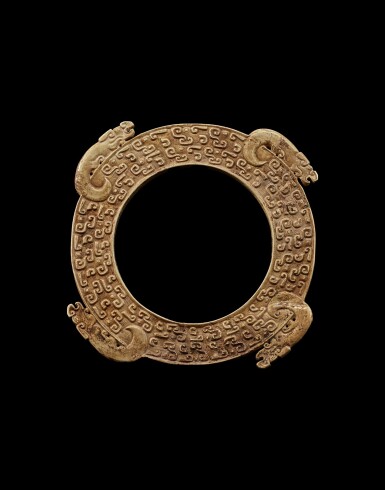
A rare jade ‘mythical beast’ flanged disc, Eastern Zhou dynasty, late Spring and Autumn period | 東周春秋晚期 四獸出廓玉璧
Estimate
400,000 - 800,000 HKD
Lot Details
Description
11.8 cm
Teng Shu-p’ing, Collectors’ Exhibition of Archaic Chinese Jades, Palace Museum, Taipei, 1999, cat. no. 162.
Tiffany Chen, Selected Works of Jade, Aurora Art Museum, Taipei, 2003, pl. 100.
Liu Yujuan and Zheng Anfeng, Masterpieces from the Collection of Aurora Art Museum, Aurora Art Museum, Taipei, 2003, pl. 19.
Wu Tanghai, Jades of Spring and Autumn Period, Aurora Art Museum, Taipei, 2010, pl. 30.
It is extremely rare to find a bi disc of this form with protruding beast-shaped notches and carved with a pattern of abstract dragons, exhibiting a unique combination of artistic innovation and technical mastery during the late Spring and Autumn period.
The disc is decorated with two concentric bands of raised hui-dragons known as panhui dragon patterns, which are arranged in a counterclockwise direction. Each dragon is formed with a circular eye, an upturned nose rendered with S-shapes and cloud patterns, and an open mouth from which a tongue extends, depicted with fine incised lines. The perimeter of the disc is further adorned with four protruding relief carvings of beast heads, a highly unusual and innovative design that sets this disc apart from typical bi disc forms.
Panhui abstract dragon patterns were popular during the Spring and Autumn period, characterised by intertwined and looping forms, reflect the aesthetic transition of the area towards geometric abstraction and stylisation. This motif was widely employed in both jade and bronze objects due to its symbolic association with auspiciousness and renewal, see a archaic bronze wine vessel from the collection of Abolala Soudavar, sold at Sotheby’s New York, 20 September 2022, lot 24. Compare a closely related bronze hu with a very similar design, together with an inscribed cover decorated with large outward-flaring lappets, from the collection of A.E.K. Cull, published in Rong Geng, Shangzhou yiqi tongkao / The Bronzes of Shang and Chou, vol. II, Beiping, 1941, pl. 743, and again in William Watson, Ancient Chinese Bronzes, London, 1962, pl. 55. Another close example is an impressive hu vessel from the Freer Gallery of Art, Washington, D.C., illustrated in George W. Wener, Jr., The Ornaments of Late Chou Bronzes. A Method of Analysis, New Jersey, 1973, pl. 76. A group of jade ornaments with similar abstract dragon patterns were excavated in Xichuan, Henan province in 1978, illustrated in Yang Boda, Zhongguo yuqi quanji, [Complete collection of Chinese jades], vol. 1, Hebei, 2005, nos.83-87.
This bi disc is particularly notable for the four beast-shaped notches extending outward from its perimeter. Such designs are rare and demonstrate a departure from the conventional circular bi form. See two related and smaller bi discs, also with notches but of a simpler design, illustrated in Yang Boda, ibid., no.68. The beasts' heads, with their pronounced features, add an additional layer of visual dynamism and symbolism to the disc. The incorporation of three-dimensional decorative elements into bi discs may have been inspired by the long-standing tradition of using animal motifs as corner adornments in bronze vessels, a practice that dates back to the Shang dynasty.
展覽
鄧淑蘋,《羣玉別藏續集》,故宮博物院,台北,1999年,編號162
出版
陳臻儀,《古玉選粹》,震旦藝術博物館,台北,2003年,圖版100
劉玉娟、鄭安芬,《文物精粹》,震旦藝術博物館,台北,2003年,圖版19
吳棠海,《春秋玉器》,震旦藝術博物館,台北,2010年,圖版30
玉質整體白化,內孔較大,璧面狹窄如環,內外緣保留圓稍粗的邊框,框內雕琢兩圈浮雕虺龍紋,以逆時針的方向鋪滿全器。虺龍紋由浮雕雲紋、穀紋和圓圈紋組成,展現出圓眼、翹鼻、張口的側面像,鼻吻下方的吐舌則用陰刻線紋表達。圓璧外圍附四頭小獸,小獸以順時針方向均勻分布,獸身用淺浮雕的技法勾勒五官與肢體。邊緣的獸尾是貼附在璧面上,並以三個鏤空小孔雕離璧緣,突出獸紋的圓雕形象。由於四獸採用立體化的方式雕琢,而且方向與璧面的虺龍紋相背,獨立在邊輪上爬行一般,極富動感,是突破傳統框架的新設計,與傳統玉壁形製相比更顯與眾不同。
蟠虺紋作為春秋時期的典型裝飾紋樣,以盤繞與交錯的形式為特徵,展現了當時幾何化與抽象化的美學轉變。該紋樣廣泛應用於玉器與青銅器中,可參考Abolala Soudavar收藏的一件青銅酒器,後出售於紐約蘇富比2022年9月20,編號24。類似設計的青銅器還見於A.E.K. Cull收藏的一件春秋青銅龍紋壺,該壺帶有銘文蓋,蓋上裝飾有外擴的大瓣葉紋,收錄於容庚《商周彝器通考》,第二卷,北平,1941年,圖版743,並再次收錄於William Watson,《中國古代青銅器》,倫敦,1962年,圖版55。另外一件相近的例子是來自美國華盛頓特區弗利爾美術館的一件壺形器,見George W. Wener, Jr.,《The Ornaments of Late Chou Bronzes. A Method of Analysis》,新澤西,1973年,圖版76。1978年河南省淅川縣下寺2號墓出土一批春秋晚期玉飾,大部分通體都飾有類似的蟠虺紋,見楊伯達編《中國玉器全集(上)》,河北,2005年,編號83-87。
此件玉璧外周四獸形紋的設計在同類器物中極為罕見,參見兩件相關的小型玉璧,亦帶有缺口,但設計較為簡約,刊於楊伯達同著錄,編號68。這種將獸形浮雕立體化並融入玉璧的表現手法,不僅增加了視覺張力,也表現了設計者對器物功能與裝飾的雙重考量。這一設計理念或可追溯至商代以來的角飾設計傳統,並在春秋晚期達到新的藝術高度。
You May Also Like


