
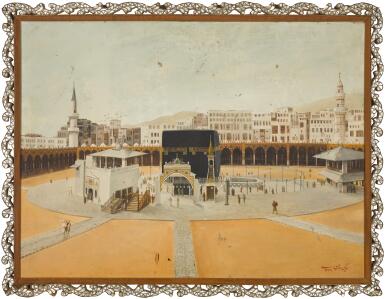
A view of the Ka’ba, by Tawfik Tarek (1875-1940), dated 1326 AH/1908-9 AD
Estimate
10,000 - 15,000 GBP
Lot Details
Description
oil on canvas, signed and dated lower right, in original mother-of-pearl inlaid wood frame
79 by 102.5cm. framed
Private collection, Canada, acquired by descent
Tawfik Tarek was a pioneering and highly influential artist in the modern era. He was born in 1875 in Damascus to a prominent military family under the Ottomans. His introduction to oil painting came during his studies at the military academy in Istanbul, however, his involvement in a nationalist political group led to his imprisonment in 1892. He was liberated from prison on the condition that he leave Istanbul, and he subsequently found asylum in Paris where he studied land surveying, painting and urbanism at the École Nationale Supérieure des Beaux-Arts. His artistic sensibilities developed and he graduated in 1901, settling in Damascus where he worked as an architect and topographer.
In Damascus, he worked in the restoration of historical sites, such as the Umayyad Mosque in Damascus where he restored an important mosaic. In parallel, he produced oil paintings largely focused on historically or culturally important Islamic scenes and figures. Stirred by the conviction that he should unveil the historic sham related by orientalist painters about Christian battles, he depicted a series of Arab battles, caliph councils and portraits that imitated famous orientalist artworks. He was also well-known for his drawings of the Mecca Pèlerinage and the Prophet’s grave, as shown in the present painting.
His independent works are informative in their presentation and executed with a high level of detail, much like the style of orientalist paintings and European landscapes. However, Tarek’s aim was to create a historic balance by appropriating the techniques orientalists used but subvert them. Bank notes that the artist’s output followed European models on the formal level but his subject matter was closely linked to his affirmation of an Arab or Syrian identity remained central to his subject matter, even his is less overtly political paintings (Bank 2016, pp.1288 and 1300).
During his life he refused to sell his works, even when facing financial difficulties. The is true of the present painting which has remained within the same family collection since it was gifted by the artist in its current, original frame in the early twentieth century. A study for an oil painting by the artist entitle Saida in Flames was sold at Sotheby’s, Doha, 13 October 2014, lot 28.
You May Also Like


