
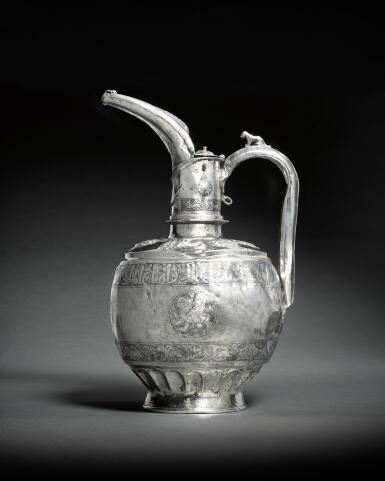
A large nielloed silver ewer, Persia or Central Asia, 12th/13th century
Estimate
250,000 - 350,000 GBP
Lot Details
Description
the rounded body with scalloped decoration to the base, on slightly splayed foot, engraved and decorated in niello with a calligraphic register in large naskh, roundels enclosing mythical creatures, and a band of animals in chase, the shoulder worked in repoussé with stylised leaves divided by panels of paired birds, the neck decorated with animals in chase, a Kufic inscription under the spout, the handle with lion terminal
37.1cm. height
22.7cm. diam.
Ex-private collection, London, pre-1970
Acquired by the present owner in London, 6 April 1995
inscriptions
‘izz da’im wa iqbal wa baqa li’l-a[mi]r al-ajall al-sayyid nizam al-dawla taj al-mu[l]k abi sa‘d ‘abd al-wahhab bin muhammad … ‘Perpetual glory and prosperity and long life for the most splendid amir, the leader, Nizam al-Dawlah Taj al-Mulk Abu Sa‘d ‘Abd al-Wahhab bin Muhammad …’ (unidentified)
On the underside of the spout: baraka da’ima wa baqa,
‘Perpetual blessing and long life’
The dramatic profile of this vessel, with its globular body and beak-shaped spout, can be related to a group of ewers attributed to north east Iran and sometimes modern Afghanistan. Two ewers of comparable shape are illustrated in Eva Baer's Metalwork in Medieval Islamic Art, one of which was found in Maimana, Afghanistan (see cat. nos.72 & 73, pp.95-96), and three similar bronze examples are published in the Aron collection (inv. nos.A 201, A 194 & A 205), see also Christie’s, 8 April 2008, lot 70; MET Museum (acc. no.59.53).
Those examples are made in brass or bronze, while the present ewer is formed of silver with engraved nielloed decoration. Other examples of this type of decoration can be found on the vessels in the ‘Harari Hoard’, attributed to the tenth and eleventh centuries. Once owned by the collector Ralph Harari and now in the L.A. Mayer Museum for Islamic Art, Jerusalem, this group encompasses silver rosewater bottles, incense burners, caskets, drinking vessels, a bowl and horse trapping, each with similar nielloed designs, combined with calligraphic bands, some with gilt details (see Hasson 2000, p.41). Important individual pieces are found in other institutional collections, including a sprinkler in the Freer Gallery of Art, Washington D.C. (inv. no.F1950.5), a Buyid wine cup in The Metropolitan Museum of Art, New York (acc. no.64.133.2) and a lidded jug in The David Collection, Copenhagen (inv. no.36/2017).
Smaller silver ewers containing an inscriptive band to the rim and roundels on the body, are illustrated in Darkevich 2009, tables 36 and 37, nos.1-2. These are said to come from the Ural region, located today in Russia, near the border with Kazakhstan; see also a ewer in the State Hermitage Museum, St Petersburg, (inv. no.797-VZ, Kuwait 1990, p.61, no.32). For further information on a bottle from this group, see Marshak 2004, pp.255-265.
The decoration of these works generally consists of calligraphic inscriptions, roundels, and bands of animal in chase, all of which are present here. The arrangement is similar to a small silver vessel, measuring 12.9cm. height, of similar globular body on short foot sold in these rooms, 30 April 2025, lot 515. The present lot is conceived on a much grander scale, but the layout of the roundels and calligraphic band is comparable. Also related to the present ewer is a lidded jug in the David Collection, Copenhagen (inv. no.36/2017). Around the neck of the Copenhagen jug is an inscription in Kufic and, in one place, a hawk attacking a duck is positioned in the space above the calligraphy. Similarly drawn birds appear in repeated panels on the shoulder of this ewer between the repoussé leaves. A goblet of this group bearing a Hebrew inscription was recently sold at Sotheby’s, New York, 29 October 2025, now housed in the Toledo Museum of Art, which exhibited fluting around the foot, similar to the base of the body here but on a more minute scale.
In most examples the inscription band is in Kufic, though here the primary inscription is in an elaborate naskh. Despite the difference in script, the calligraphy retains the same bold line and creative flourish as found in many of its Kufic counterparts. A jug sold in these rooms, 27 October 2021, lot 169 also incorporated an inscription in cursive although in a less formalised and less overtly calligraphic script. Notably, the inscription includes the name of a patron, Nizam al-Dawlah Taj al-Mulk Abu Sa‘d ‘Abd al-Wahhab ibn Muhammad. Unfortunately, he has not been thus far recorded but must have been a figure of considerable means to commission such an object on this grand scale.
You May Also Like


