
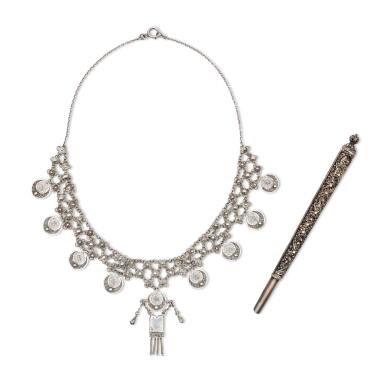
A Bezalel Silver Filigree Pen and Necklace, Jerusalem, both retailed in Warsaw, circa 1910
Estimate
5,000 - 8,000 USD
Lot Details
Description
Silver filigree pen, the finial screws off to reveal a small paper knife, in fitted box stamped " Societe Bezalel Varsovie" marked on blade with Bezalel maker's mark and Russian import mark
length 6 1/8 in.
15.5 cm
the silver necklace hung with nine pendants enclosing the Star of David, the central one hung with a tablet-form charm engraved with Hebrew Inscription If I forget thee oh Jerusalem, let my right hand forget her cunning; (psalm 137:5), in fitted case stamped " Societe Bezalel Varsovie", marked on center pendant with Bezalel in Hebrew and with Russian import mark
length of chain 19 in.
48.2 cm
These two pieces and their fitted cases are rare documentary evidence of early Bezalel items being directly marketed in Europe, before World War I, in Warsaw, a city then part of the Russian Empire - with a significant Jewish population. Boris Schatz would write of the Bezalel filigree work, "In all my years of running Bezalel this was the best-selling merchandise... both to the tourists here and at the exhibitions I arranged in Germany, Austria, Russia, England and America."
The Bezalel Societies and the Warsaw Bezalel Society
From the earliest years of the Bezalel School of Arts and Crafts, a vast international network of Bezalel Societies arose to support, finance, and distribute the school’s artistic production. These organizations—established in cities such as Berlin (1905), Hamburg (1908), Prague (1909), and Warsaw (1910)—played a crucial role in securing Bezalel’s financial stability and extending its reach far beyond Jerusalem. Their tasks ranged from raising funds for the school and purchasing raw materials to promoting Bezalel art abroad and cultivating local markets receptive to its fusion of Jewish tradition, nationalist symbolism, and Arts and Crafts design.
Among all these groups, the Warsaw Bezalel Society quickly emerged as the most successful and influential. Founded in 1910 after a highly acclaimed Bezalel exhibition in the city, the society was established by Meir Vishniak, Leon Lewita, Benjamin Minz, and Abraham Podlishevsky with an unusually large endowment of fifty thousand rubles. Under Lewita’s direction—and in close communication with Boris Schatz—the Warsaw society secured exclusive rights to distribute Bezalel merchandise throughout the Russian Empire, an enormous commercial territory. Their position was so strong that their fitted cases and packaging, often stamped “Société Bezalel Varsovie,” became hallmarks of authenticity for objects sold in Eastern Europe.
The Warsaw society was not merely a sales agent but an active collaborator. Like other Bezalel Societies, it sometimes commissioned items tailored to local tastes and even reserved the right to make minor adaptations using local craftsmen. In return, the society supplied critically needed materials—silver, books, tools, and equipment—for Bezalel’s workshops, library, and museum. By 1913, Bezalel boasted 7,000 individual members, 53 patrons’ organizations, and 148 affiliated societies worldwide, but none were as closely linked or as commercially dynamic as the Warsaw branch. Objects such as the present silver filigree pen and necklace—bearing Bezalel workshop marks and housed in cases stamped “Société Bezalel Varsovie”—are rare and eloquent witnesses to this flourishing international network.
Another example of the pen handle with knife was shown in the exhibition catalogue Bezalel, 1906-1929, edited by Nurit Shilo-Cohen (Israel Museum, 1982), Item 741.
An early silver Bezalel Hanukkah Lamp in a similar case stamped "Societe Bezalel Varsovie" was sold Bonham's, London, 24 March 2005, lot 54.
You May Also Like


