
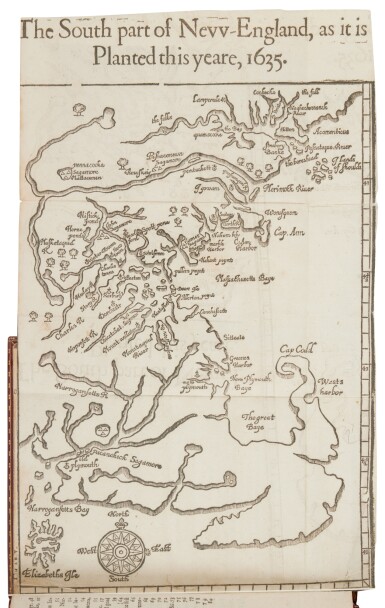
Wood, William | The first detailed cartographical view of Massachusetts
Lot closes
December 16, 03:45 PM GMT
Estimate
35,000 - 50,000 USD
Starting Bid
30,000 USD
We may charge or debit your saved payment method subject to the terms set out in our Conditions of Business for Buyers.
Read more.Lot Details
Description
Wood, William
New Englands Prospect: A True, Lively and Experimental Description of That Part of America. London: Thomas Cotes for John Bellamie, 1635
Small 4to (180 x 140 mm). Folding letterpress and woodcut map (state 2, dated 1635); upper margins of text trimmed, occasionally shaving page numbers and headlines, old stains on title (possibly washed), old worm track repaired in some blank outer margins, a crisp impression of the map. Old crimson morocco by Myers; old bookplate removed from pastedown. Half morocco and cloth box.
Second edition, reprinted from the first edition of 1634. The map, the first detailed cartographical view of Massachusetts, is from the same woodblock as in the first edition but has a reset typographic heading. Little is known of the author, who was resident in New England from 1629 to 1633, likely in Lynn. His is the first map of Massachusetts by a resident and is remarkably accurate.
The map “extends from the New Hampshire coast northeast of the Pescataqua River south to Narragansett Bay. New Plymouth is properly located where the Pilgrims first settled, but the name of Old Plymouth on the mouth of the Narragansett River is difficult to explains since there was no settlement there until 1680. Other towns depicted on the map include Mount Wollaston (Braintree), Roxbury, Boston, Watertowne, Newton (Cambridge), Charlestowne, Meadford, Winnisimet (Chelsea), Sagus (Lynn), and Dorchester, referred to in Wood’s book as the ‘greatest town in New Englans’” (Shwartz & Ehrenberg).
In an engaging prose style Wood provides the earliest topographical description of the Massachusetts colony and the first detailed account of animals and plants to be found there (including the "hurtful things" such as mosquitoes and rattlesnakes).
Part II of the work is devoted to a detailed narrative of the Indian peoples of New England, their clothing, hunting, sports, games and language, including a five-page glossary. "Of particular note is the chapter on the customs and work of Indian women" (Celebration).
Wood may have returned to British America after sailing to England to publish this account. The General Court of Massachusetts Bay voted thanks to Wood on the appearance of New Englands Prospect. The charm and vivacity of Wood's writing, including flights of verse, is widely acknowledged.
REFERENCES
Celebration of My Country 4; Burden 239 (map); Church 433; European Americana 635/134; Pilling, Algonquian 535; Schwartz & Ehrenberg, p. 100 (map, 1634 issue); STC 25958; Vail, Old Frontier 89
PROVENANCE
Barbara and Ira Lipman (Sotheby's New York, 13 April 2021, lot 548)
You May Also Like


![Mendeleev, Dmitri Ivanovich | First edition of Osnovy khimii [Principles of Chemistry], with two early versions of the periodic table, St. Petersburg, 1869–1871](https://dam.sothebys.com/dam/image/lot/347ce25c-7614-4b4a-9cb7-e0a15dddd638/primary/extra_small)


![Pieter Schenk | Nova totius Asiae tabula, Amsterdam, [c.1710]](https://dam.sothebys.com/dam/image/lot/b211afed-e8c5-48bd-ab4f-cf03887674db/primary/extra_small)

