
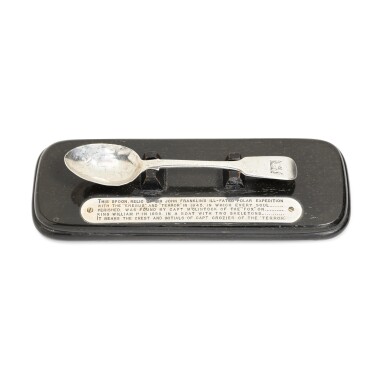
Silver hallmarked teaspoon with initials of Captain Francis Crozier, an exceptionally rare relic from the Franklin Expedition
Lot closes
December 11, 03:27 PM GMT
Estimate
8,000 - 12,000 GBP
Starting Bid
6,000 GBP
We may charge or debit your saved payment method subject to the terms set out in our Conditions of Business for Buyers.
Read more.Lot Details
Description
A silver teaspoon owned by Captain F.R.M. Crozier
(15 x 145 x 31 mm), with Dublin hallmarks, dated 1839-40, and the maker's mark of Josiah Low (initials "IL"), with the Crozier family crest (a griffin's head and wings displayed, argent) engraved on front of the front of the handle and the owner's initials ("FRMC" for Francis Rawdon Moira Crozier) engraved on the back near the bowl, resting on a wooden base (29 x 203 x 74 mm) with engraved silver plaque commemorating that the spoon was "found by Capt. M'Clintock of the "Fox" on King William I[slan]d in 1859, in a boat with two skeletons", some wear to spoon
[with:]
1 page autograph letter signed from Cecil D. Crozier to Miss Lefroy, dated 3 December 1926, writing to her "about Dr. Guillemand's letter", identifying the crest on the spoon as that of the Crozier family, and referring to McClintock's account of the discovery of relics from the Franklin Expedition, 8vo, previously folded, in envelope
AN EXCEPTIONALLY RARE RELIC FROM FRANKLIN'S DOOMED EXPEDITION TO THE NORTH-WEST PASSAGE.
The 129-strong Franklin Expedition, conveyed in HMS Erebus and HMS Terror, departed from England in 1845. The aim of the expedition was to traverse the final unnavigated sections of the Northwest Passage whilst recording magnetic data. Tragically, the expedition met with disaster after the two ships became icebound. The relics recovered from subsequent expeditions serve as tantalising material clues as to the disastrous circumstances faced by Franklin and his men, circumstances still not fully understood to this day.
Quotidian items like cutlery served an important role in allowing subsequent explorers to piece together what happened on Franklin's ill-fated expedition. Notably, in 1854, the objects that John Rae purchased from local Inuit helped lead him to the startling conclusion that Franklin's men had resorted to "the last dread alternative" of cannibalism in their final desperate days. The items bought by Rae included a similar spoon, also bearing the initials and family crest of Francis Crozier (Franklin's second-in-command and the Captain of HMS Terror).
Rae's discoveries, though highly controversial at the time, provided a vital evidence base for the subsequent revelations made during Francis Leopold McClintock's Arctic expedition of 1857. McClintock's expedition, during which the present spoon was discovered, was the fifth undertaking privately financed by Lady Jane Franklin, with the dual aims of locating Franklin's men and securing any possible claim on Franklin's part as to the discovery of the Northwest Passage. McClintock was an Arctic explorer of some repute, and experience taught him the importance of taking the oral testimony of the indigenous population seriously—a lesson which had proved instrumental in allowing Rae before him to unravel some of the mystery. McClintock's expedition famously discovered the so-called "Victory Point" note, a vital document giving written testimony of the death of Franklin. Later that same month, on 24 May 1859, Lieutenant Hobson stumbled upon a large boat containing two skeletons as well as an array of objects including silverware:
"In the after-part of the boat we discovered eleven large spoons, eleven forks, and four teaspoons, all of silver; of these twenty-six pieces of plate, eight bore Sir John Franklin’s crest, the remainder had the crests or initials of nine different officers… of these nine officers, five belonged to the 'Erebus'... Three others belonged to the 'Terror'— Crozier (a teaspoon only), Hornby, and Thomas" (McClintock, The Voyage of the 'Fox' in the Arctic Seas, p. 297).
In some ways, Hobson's discovery of the silverware in the boat raised more questions than it answered. McClintock proposes that "Sir John Franklin's plate was perhaps issued to the men for their use, as the only means of saving it; and it seems probably that the officers generally did the same", though he notes with curiosity that "not a single iron spoon, such as sailors always use, has been found" (Ibid., pp. 297-8). It is odd that the men do not appear to have instead made use of the hard-wearing pewter utensils available aboard ship when confronting the prospect of extreme hardship and exposure to the elements. Plausibly, the officers' plate was taken from the ships for the purpose of bartering with the local Inuit in exchange for seal meat and other commodities, as Russell Potter suggests. Or perhaps these impractical objects served as a bold symbolic statement of Victorian colonial ambition: representing the heroic efforts of the British to bring civilisation to one of the most inhospitable environments on the planet, against all odds.
REFERENCES:
For an identical teaspoon, bearing the same Dublin hallmarks, maker's mark, and initials/family crest of Crozier, see National Maritime Museum, Greenwich, item AAA2489; Francis McClintock, The voyage of the 'Fox' in the Arctic seas: A narrative of the discovery of the fate of Sir John Franklin and his companions (London, 1859), pp. 297-8; for an account of the Rae and McClintock expeditions, see Michael Palin, Erebus: the Story of a Ship (London, 2018), pp. 249-262.
You May Also Like


