
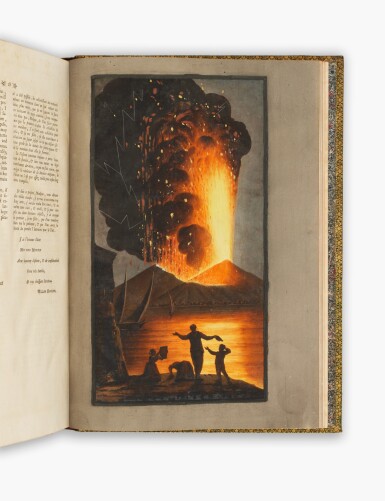
Hamilton, Sir William | The Botfield copy of the spectacular Campi Phlegræi, London, 1776–1779
Live auction begins on:
December 9, 08:00 PM GMT
Estimate
40,000 - 60,000 USD
Bid
32,000 USD
Lot Details
Description
Hamilton, Sir William
Campi Phlegræi. Observations on the Volcanos of the Two Sicilies as they have been communicated to the Royal Society of London … Observations sur les volcans des Deux Siciles. Naples: [for Peter Fabris], 1776 — Supplement to the Campi Phlegræi being an Account of the Great Eruption of Mount Vesuvius in the month of August 1779. Communicated to the Royal Society of London … Supplement au Campi Phlegraei. Naples: [for Peter Fabris], 1779
3 parts, including Supplement, in one volume, folio (440 x 305 mm). 59 fine handcolored plates after Fabris, the margins of each plate framed with black edging and gray wash borders, full-sheet handcolored map by Joseph Guerra, title-pages in English and French, text in double columns of English and French, the text for most plate captions imposed horizontally, type-ornament rules, shoulder-notes; plate 40 lightly stained at right edge mostly affecting border, a few plates lightly spotted or with traces of tissue guards adhered or abraded. Nineteenth-century English green straight-grained morocco, the covers with decorative border of Greek-key pattern roll between double fillets, floral cornerpieces, just inside the Greek-key roll, a stylized foliate roll, central gilt Botfield arms, spine gilt in seven compartments with raised bands, lettered in the second and seventh, board edges and turn-ins decorated with gilt rolls, marbled endpapers, gilt edges; extremities and front cover a little scuffed, spine lightly faded.
A fine copy, with distinguished provenance, of the first edition of Hamilton's superb and justly famous study of volcanic phenomenon, which "still holds its reputation as one of the most trustworthy historical and scientific accounts of Mount Vesuvius" (Zittel, History of Geology p. 45).
Hamilton was the British minister plenipotentiary at the court of Naples for most of the second half of the 18th century. Although he secured the neutrality of Naples during the American Revolutionary War, his official duties were not taxing, and much of his time was devoted to his twin passions of antiquities and volcanoes. Hamilton engaged the English expatriate artist Peter Fabris to make drawings to accompany his letters to the Royal Society describing the volcanic activity of the region. Hamilton and Fabris made more than twenty ascensions of Vesuvius, frequently placing themselves in danger in order to study and sketch the volcano at all stages of eruption. The published plates, which frequently portray the red-coated Hamilton engaged in observation, are, as the author noted in his introductory letter, "executed with such delicacy and perfection as scarcely to be distinguished from the original drawings themselves" (p. 6). In addition to the views of Vesuvius, Etna, and Solfaterra, both dormant and in eruption, the plates also include representations of many specimens of volcanic rock, lava, tufa, ash, and other matter. Hamilton presented his collection of volcanic stone and minerals to the British Museum in 1767.
REFERENCES
Lewine 232
PROVENANCE
Beriah Botfield (Christie’s London, 30 March 1994, lot 65; Sold by Order of the Trustees of the Bath Settled Estates)
You May Also Like


