
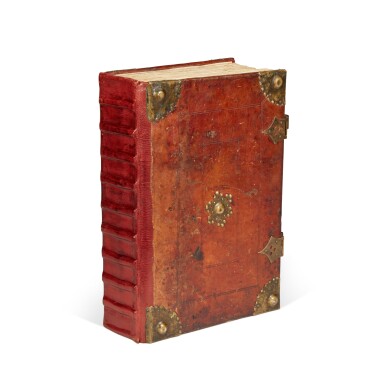
Bible with Prologues and Interpretations of Hebrew Names, in Latin | Italy, probably Bologna | dated 1273 |
Lot closes
December 9, 02:16 PM GMT
Estimate
150,000 - 200,000 GBP
Starting Bid
130,000 GBP
We may charge or debit your saved payment method subject to the terms set out in our Conditions of Business for Buyers.
Read more.Lot Details
Description
370 x 250 mm, illuminated manuscript on vellum, Bible with Prologues and Interpretations, Italy, [probably Bologna], likely by a Master of the Primo Stile, dated 1273, binding 15th century; ii+512+i leaves, quire signatures ‘a’ to ‘r’ (ff.1-201), too tightly bound to allow confident collation, 2 columns of 45 lines (ca. 233 x 70-15-70 mm), written in an attractive Littera Bononiensis; 72 historiated initials with foliate extensions at beginning of biblical books, f. 1r with an angel at the bas-de-page, 73 decorated foliate initials at beginning of prologues and explicits, flourished initials for chapters, occasionally with tiny instructions in brown ink in upper and outer margins, lacking leaves with historiated initials at the beginning of Genesis, 2 Chronicles, Ezra I, Job, Psalms, Song of Solomon, Isaiah, Ezekiel, Daniel and Matthew, and a few text leaves at the end (the Interpretations of Hebrew names ending in the ‘O’s); first leaf rubbed, a few quires at beginning with vertical creases, text occasionally rubbed and margins stained but historiated and decorated initials generally in very fine condition, a few text leaves in quire ‘g’ affected by water damage, chapter numbers and running headers adapted where gaps occur; 15th-century Italian brown leather binding with original brass bosses over wooden boards, rebacked, new clasps.
A BEAUTIFUL AND IMPRESSIVE LECTERN BIBLE. THE CENTRAL BOOK FOR LIFE AT THE MONASTERY
PROVENANCE
1. A colophon at the end of the Apocalypse provides the date 1273: "Explicit Apocalypsis Iohannis. M.CC.lxxiij. Indictione prima" (f.487v). The book was perhaps made for a Dominican convent: the Psalm 97 initial depicts a choir of chanting Dominicans (f.242r), and the first flyleaf has a rust-stain near the middle of the top edge, probably from a chain-staple, suggesting that the volume was chained in an institutional library.
2. S.W. Rosenbach (1876–1952), Philadelphia.
3. John Fleming.
4. Dr. Charles Caldwell Ryrie, acquired from the above.
5. Sotheby's, New York, December 5, 2016, lot 8.
6. The Alana Collection Private Collection, New York, acquired 2016.
COMMENTARY
This large Bible was likely made by and for a Dominican monastery in Bologna. At the beginning of Psalm 97 (Vulgate), we can spot in the historiated initial C on fol.242r, a group of Dominican monks wholeheartedly signing in front of a lectern, indicating a potential use of the manuscript in a Dominican context. The Dominican order was founded in 1215/16 by the Spaniard Dominic de Guzmán (1170-1221), who arrived in Bologna in 1218 and recognised the importance of the region as a centre for learning and manuscript production. Alongside the University of Bologna, the Dominican order quickly became a driving force for manuscript production in Italy. New chapters were founded in rapid succession all over Italy, and every new foundation required a large-format Bible for use in the refectory and at Mass, as well as a smaller copy for the library.
The Bible at hand, with its impressive format of almost 40 by 25 cm, is a so-called ‘lectern Bible’. As the name reveals, these manuscripts were used for public reading in the choir and were often proudly put on display (Lobrichon 2023, p.192). This type of Bible was also used for reading during the mealtimes in the refectory. The Bible at hand was rebound in the 15th-century and still bears the original brass bosses, which elevate the manuscript from the surfaces it is placed upon – very useful when using a manuscript in the refectory. The new binding demonstrates the continuous use and appreciation of the manuscript.
This complete Italian Bible with its almost 150 initials, offers a fascinating glimpse into the religious landscape of 13th-century Northern Italy, demonstrating the rise of the Dominican order and the ground-breaking developments in manuscript production for religious houses in Italy.
TEXT
The text of this Vulgate Bible is essentially that of a standard 13th-century Bible as defined by Neil Ker (Medieval Manuscripts in British Libraries, I, pp. 96-7, etc.), with the usual prologues and interpretations of Hebrew names beginning ‘Aaz apprehendens,’ however, it contains a considerable number of additional prologues (to Ezra, Jeremiah, Hosea, and most of the other prophets, and in the New Testament to Romans and 1 Corinthians).
The details of the main biblical text might offer further insight into our understanding of Bolognese Bible production: alongside the beginning of Nehemiah, for example, is a scribal note in cursive script, heavily abbreviated, that appears to suggest that he was unable to correct the text because it was not in his second exemplar: Iste tercius liber [i.e. III Ezra] non co(rrectus?). quod non est in … exemplari.
DECORATION
ECHOS OF A DISTANT PAST: BYZANTINE MODELS IN ITALIAN MANUSCRIPT ILLUMINATION
72 historiated initials adorn this Bible, including large, flourished initials at the beginning of chapters. The decoration is reminiscent of the work of the Masters of the Primo Stile, a style of illumination influenced by the then archaic modes of Byzantine art. Human figures are characterised by their dark blueish shadows around the eyes and contouring facial features, high foreheads, and square face shapes, referencing Byzantine models. Lips and cheeks are marked by dots of strong red colour, which are more pronounced in younger figures.
The first page of each book and the psalms are embellished with large historiated initials. The decoration is generally of high quality and in very fine condition. Predominant in the manuscript are dark, intense blue backgrounds, highly polished and finely punched gold nimbi, and flesh tones tinted in green, blue and red.
Dorothy Miner ascribed this manuscript to a group of Bibles generally attributed to Bologna. This manuscript stands out through its "looser, freer use of modelling" that Miner also recognised in a very fine Bible in the Dyson Perrins sale in our rooms, 1 December 1959, part II, lot 61 with pl.11, sold for £14,000 to Maggs.
The subjects of the historiated initials are:
(1) St Jerome handing his epistle to a messenger; an angel in the lower margin (f.1r)
(2) St Jerome holding a book (f.3v)
(3) Moses addresses the Israelites(?) (f.23v)
(4) God addresses Moses from a tower (f.39r)
(5) God addresses Moses from heaven (f.50v)
(6) Gideon selects his army by seeing which soldiers bend down to drink from the river (f.66r)
(7) The Death of Moses (f.80v)
(8) The Death of Joshua (f.90v)
(9) Elimelech, Naomi, and their two sons (f.101r)
(10) Elkanah kneels before an altar, with his two wives, Hannah and Peninnah (f.103v)
(11) Saul is killed with his own spear by the Amalekite (above), and the Amalekite presents Saul’s crown to King David, who rends his clothes (below) (f.118v)
(12) Abishag brought to King David (f.131r)
(13) King Ahaziah falls from his palace tower (f.145r)
(14) Adam and his descendants (f.159r)
(15) King Cyrus orders the rebuilding of the Temple (f.185v)
(16) Moses and an Elder placing the tablets of the law into the Ark of the Covenant (f.194r)
(17) Tobit blinded by the swallow (f.200v)
(18) Judith beheading Holofernes (f.204v)
(19) Ahasuerus (above) extends his sceptre to Esther (below) (f.210v)
(20) Job on the dungheap, with his wife and friends (f.216v
(21) David pointing to his eyes (f.229r)
(22) David pointing to his mouth (f.231v)
(23) The Fool (f.234r)
(24) God speaking to David in water (f.236v)
(25) David playing a viol (f.239v)
(26) Dominicans singing at a lectern (f.242r)
(27) Christ as Judge (f.245r)
(28) Solomon instructing Rehoboam (f.251r)
(29) Solomon enthroned holding an astrolabe(?) (f.260r)
(30) Solomon as judge with sword and scales (f.264r)
(31) Christ and Jesus of Sirah? (f.270v)
(32) ?Jeremiah depicted as a young man (f.272v)
(33) Jeremiah and the almond Rod and Boiling pot (f.273r)
(34) ?Jeremiah addressing the scribe Baruch (f.300r
(35) ?Hosea and Gomer (he is dressed as a friar saint) (f.335r)
(36) Joel preaching to birds (f.338v)
(37) Amos as shepherd (beating two wolves?) (f.340r
(38) Obadiah feeding the poor prophets (f.343r)
(39) Jonah and the Whale (f.343v)
(40) The Judgement of Micah (f.344v
(41) Micah and the destruction of Samaria (f.346v)
(42) The angel carrying Habakkuk by his hair to Daniel in the lion's den (f.348r)
(43) Zephaniah (f.349v)
(44) Zerubbabel and the rebuilding of the temple (f.351r)
(45) Angel with The Woman in a Basket (Zechariah 5:5-11) (f.352r)
(46) Malachi with offering of silver (wheat?) (Malachi 3:4) (f.356r)
(47) Battle between Kings Alexander and Darius (f.357v)
(48) Delivery of the A Letter to the Jews in Egypt (f.372r)
(49) St Mark’s symbol, a Lion-headed man (above), St Mark (below) (f.395r)
(50) St Luke’s symbol, the Calf (above), St Luke (f.403v)
(51) Eagle-headed man (f.418v)
(52) St John’s symbol, the Eagle (above), St John (below) (f.419r)
(53) St Paul with sword and Letter to the Romans (f.431v)
(54) St Paul with his letter to the Corinthians (f.437v)
(55) St Paul escaping from Damascus in a basket (f.443r)
(56) St Paul and a bishop (Cephas?) (f.446v)
(57) St Paul's letter to the Ephesians (f.448v)
(58) St Paul, hands bound with his girdle at Philippi and imprisoned (Col 4:18) (f.451r)
(59) St Paul sending Timothy with his letter to the Thessalonians (f.452r)
(60) St Paul sends his second letter to the Thessalonians (f.453v)
(61) St Paul and a bishop (f.455v)
(62) St Paul charges Timothy with preaching the word of God (f.455v)
(63) St Paul and Titus (f.456v)
(64) St Paul’s letter to Philemon (f.457v)
(65) St Paul addressing the Hebrews (f.457v
(66) St James addressing God (f.476r)
(67) St Peter sending his first epistle (f.477v)
(68) St Peter sending his second epistle (f.479r
(69) St Jude (f.480r)
(70) St John (f.480r)
(71) The Revelation to St John (f.480v)
(72) A Friar/Monk saint (f.488r)
LITERATURE
Formatting the Word of God. An Exhibition at Bridwell Library, Southern Methodist University, 1998, eds. Valerie Hotchkiss and Charles C. Ryrie. Wind River Press, Austin, Texas.
Gothic and Renaissance Illuminated Manuscripts from Texas Collections (exhibition catalogue), April 23 – June 23, 1971, ed. Miriam Lutcher Stark Library, University of Texas at Austin, no. 5 pp. 12, 16–17, illus.
Lobrichon, Guy (2023). "The Production of Medieval Bibles". In H. A. G. Houghton (ed.). The Oxford Handbook of the Latin Bible. pp.187–207.
FURTHER READING
Medieval Manuscripts in British Libraries, I, pp. 96–7, etc.
You May Also Like


![Diogenes Laertius, Epistolae Bruti, [Venice, 1492], binding by Mahieu's Aesop Binder for Jean Grolier](https://dam.sothebys.com/dam/image/lot/1f338a84-3760-4404-b6bd-39b63c6fcdd2/primary/extra_small)


![[Bible] Psalterium, Venice, Aldus, [not after 1498], contemporary Roman medallion binding](https://dam.sothebys.com/dam/image/lot/a242219d-63e5-4bd6-83b3-a9923c537bed/primary/extra_small)
