
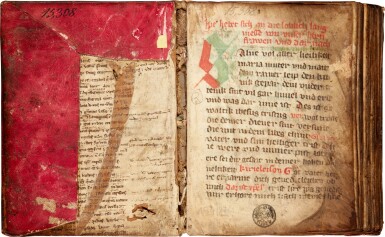
Book of Hours in German, Use of Nuremberg(?), with Latin incipits | Germany (Nuremberg?) | 2nd half of the 14th century
Lot closes
December 9, 02:15 PM GMT
Estimate
18,000 - 24,000 GBP
Starting Bid
17,000 GBP
We may charge or debit your saved payment method subject to the terms set out in our Conditions of Business for Buyers.
Read more.Lot Details
Description
c.150 × 115mm, 78 leaves, apparently complete, i-vi10, vii14 (back paste down bound with this quire, creating the impression of an incomplete gathering, however, text of this quire is complete), viii4, no apparent evidence that there was ever a calendar or any other additional material that has been removed, pastedowns comprising of two partial 13th-century French leaves of Ovid’s Amores, i.14 (front), and ii.7 to ii.8 (back), with extensive interlinear and marginal glosses; written in Gothic bookhand (quire 8 likely by a different scribe), ruled in lead point for 20–21 lines per page; rubrics in red, 1-, 2-, and 3-line initials in red, one 6-line initial in red and green, head of page foliated in 15th/16th-century roman numerals in ink and in 19th-century Arabic numerals in pencil; contemporary binding sewn on three double bands laced into slightly bevelled wood boards, flush with the leaves, covered with red-stained leather, recesses in the back board for the straps of two strap-and-pin clasps, the pins still present in the front board, apparently unrestored; binding darkened on the outside but still bright and vibrant on the wide turn-ins, leaves darkened in margins, not affecting text legibility, clear marks of usage due to the nature of the book.
GERMAN BOOK OF HOURS WITH THE ONLY RECORDED USE OF NUREMBERG. A FASCINATING WITNESS TO VERNACULAR DEVOTIONAL PRACTICES
PROVENANCE
1. It is likely that the manuscript was made in Nuremberg; among the confessors in the list of saints in the litany are Willibald (venerated at Eichstatt, south of Nuremberg) and Sebald, the patron Saint of Nuremberg, the ‘S’ of his name executed in red – the only saint whose name has been distinguished in this fashion. The main text ends with a request that anyone who finds the book should return it to master Walter S.: ‘Quis hoc invenit <…>endi(?) domino Waltero S<…>burg(?) reddere debet’, and two more lines, perhaps in German (more thoroughly erased).
2. Joseph Baer & Co., Frankfurt booksellers from 1785 to 1934; provisionally sold in 1860 to:
3. Hans Philipp Werner (1801–1872), Freiherr von und zu Aufseß: passed by him for accessioning by:
4. The Germanisches Nationalmuseum, Nuremberg (of which von Aufseß was the Director): with their number inscribed in 19th-century ink ‘15,308’ (front turn-in; the same number in pencil on the first page), and their circular ink-stamp (an eagle in a circle; Lugt no. 2809); the Museum accession register for 2 May 1860, however, records ‘All works from this purchase [‘from bookseller Bär’] (Nos. 15299–319) [including no. 15308] returned to V. Aufseß as a result of the disagreement with Bär’; presumably there was a misunderstanding between Aufseß and Baer about the price, and the 21 items were returned by the former to the latter. Dr. Johannes Pommeranz, Head of the Library at the Germanisches Nationalmuseum, confirms that the manuscript has not been stolen from the museum, despite bearing its stamp and accession number.
COMMENTARY
German vernacular Books of Hours, like the manuscript at hand, are a precious rarity that offer fascinating insights into the changing devotional landscape of medieval Europe. Jeffrey Hamburger states that only around 50 Books of Hours in German are extant (Hamburger in Bilderwelten 2017), with most of them being held at German institutions. While other countries, like the Netherlands, had a strong tradition of vernacular Books of Hours early on, the German-speaking regions never produced vernacular Books of Hours to the same extent. While prayer books in the German dialects are not uncommon and formed an important part of devotional culture, Books of Hours in German are absolutely rare.
The manuscript at hand, therefore, offers a rare occasion of a German translation of the Latin text for the Hours of the Virgin and the Office of the Dead, likely for an owner who did not know Latin but who wanted to follow the Latin mass – a fact hinted at by the Latin cues in the text. The desire to understand texts at the heart of devotional practices is a very human notion and hints at the paradigm shift in religious practices, foreshadowing the Reformation, which would change the face of Christian religion irrevocably.
The liturgical Use for both the Hours of the Virgin and of Office of the Dead appear to be unrecorded, as it is absent from Erik Drigsdahl’s tables for the Hours of the Virgin and from Knud Ottosen’s tables for the Office of the Dead. In this case, the text offers a unique witness to the daily liturgical practice of one of the major German cities. The fact that the final quire, which mentions St Sebald, is apparently a near-contemporary addition, may indicate that the book was produced in another location and was subsequently adapted for Nuremberg. Despite this, the liturgical Use is still likely unique and further research is needed to establish the exact city or diocese for which it was intended.
TEXT
[Items 1–3 occupy quires 1–7]
1. ff.1r–5r, Mass of the Virgin: ‘Hie hebet sich an die loblich lang messe von unser liben frawen und dar nach. Salve vol aller heilikeit Maria muter vnd mait dem rainer leip den kunik gepar …’, mostly in German, with occasional Latin cues.
2. ff.5r–38r, Hours of the Virgin: ‘Hie sebt sichan die metten. Domine labia meaaperies. Herre du auf mein lebsen das mein munt kunde … das sint laudes metten. (fol. 12v) … Das ist preim (fol. 19v) … Terz (fol. 23r) … Das ist die sexte (fol. 25r) …Die none (fol. 27v) … Vesp(er) (fol. 29v) … Completorium (fol. 34v) …’
3. ff.38r–59r, Hours of the Passion, mostly in German, with Latin cues: ‘Incipit cursus de passione domini. Domine labia mea aperies. Herre tu auf mein lebsen …’, with Lauds (fol. 41r), Prime (fol. 42v), Terce (fol. 43v), Sext (fol. 44v), None (fol. 46r), Vespers (fol. 47r), and Compline (fol. 49r).
4. ff.54r–59, Prayers, in German: ‘Das gepet sprech der mensch … Von der olung… Dar nach get aber ein …’
5. ff.59r–74v, Office of the Dead, an unrecorded Use, in German with Latin cues: ‘Das ist die vigilg &cet(er)a. Verba mea auribus percipe domine intellige clamorem meum. Herre v(er)nim mein wort mit demen oren …’; followed by an erased inscription (see Provenance).
[Items 4–5 occupy quire 8]
6. ff.75r–76v, Two prayers in German: ‘Eva du lebentigew fruht …’, and: ‘Herre hilf mir das ich dich also enpfangen …’
7. ff.76v–78v, Litany of saints and petitions.
LITERATURE
Unpublished.
FURTHER READING
Jeffrey F. Hamburger, Béatrice Hernad, Karl-Georg Pfändtner, Robert Suckale, Gude Suckale-Redlefsen, Bilderwelten. Buchmalerei zwischen Mittelalter und Neuzeit exhibition catalogue of the Bavarian State Library, 13th April 2016 to 24th February 2017 ed. Bavarian State Library.
You May Also Like


![Diogenes Laertius, Epistolae Bruti, [Venice, 1492], binding by Mahieu's Aesop Binder for Jean Grolier](https://dam.sothebys.com/dam/image/lot/1f338a84-3760-4404-b6bd-39b63c6fcdd2/primary/extra_small)


