
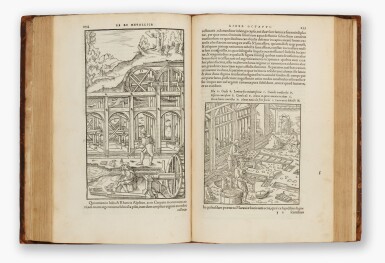
Agricola, Georgius | A "book that has earned its place in history as a masteriece of Renaissance technical writing and technical illustration," Basel, 1556
Live auction begins on:
December 9, 08:00 PM GMT
Estimate
20,000 - 30,000 USD
Bid
16,000 USD
Lot Details
Description
Agricola, Georgius
De re metallica libri XII. Qvibus officia, instrumenta, machinæ, ac omnia denique ad metallicam spectantia, non modo luculentissimè describuntur, sed & per effigies, suis locis insertas, adiunctis Latinis, Germanicisque appellationibus ita ob oculos ponuntur, ut claris tradi non possint. Eivsdem De animantibus svbterraneis liber. Basel: (Hieronymus) Froben (and Nicolaus Episcopius, March), 1556
Folio (321 x 212mm). Roman and italic types, with a little Greek and gothic, woodcut printer's device on title and last page, 263 woodcut illustrations (many full-page) by Hans Rudolf Manuel Deutsch and, perhaps, Blasius Weffring, 2 leaves 7 woodcut illustrations intended to be cut apart and assembled as a volvelle quired around i1–i2, 27 woodcut diagrams,14 nine-line historiated woodcut initials, α6 blank and genuine, eighteenth-century marginal note in English regarding units of measure on k6v, some earlier manicules and later penciled marginalia; title-page and final page dust soiled, occasional light marginal staining and soiling, a very few stray, marginal wormholes, withal a very good, clean copy. Eighteenth-century English paneled calf, red-sprinkled edges; extremities worn and restored, rebacked to style.
First edition of “The first systematic treatise on mining and metallurgy and one of the first technological books of modern times” (Printing and the Mind of Man). Published posthumously, De re metallica “remained the leading textbook for miners and metallurgists for nearly two centuries. At a time when most industrial processes were held secret by families, guilds, or towns, Agricola saw fit to publish every practice and improvement that he considered of value, and to use Latin to gain the widest circulation in his homeland and abroad. He had little to draw on from earlier sources that had any practical value” and labored on the text for the final two decades of his life (Dibner, Agricola, p. 25).
The twelve books of De re metallica survey all aspects of the mining industry and metallurgical process of the Renaissance, including the mines themselves, administration of companies, tools and machines, prospecting, ore extraction, assaying, smelting, and illnesses and accidents common to miners. De re metallica is one of the great printing achievements of its era, providing a brilliant integration of fine woodcut illustrations with a highly technical text.
David Kuhner terms De re metallica “a book that has earned its place in history as a masterpiece of Renaissance technical writing and technical illustration,” and Helmut Wilsdorf records in Dictionary of Scientific Biography that Agricola met with Blasius Weffring to plan the design and illustration of the book. The vivid woodcuts depict furnaces, hydropower, pumps, ventilation systems, and other practical applications of mechanical engineering-including one of the first illustrations of a railroad. In addition to its principal subjects of metallurgy and geology, Agricola's treatise discusses glassmaking, the preparation of saltpeter and nitric acid, magnets and divining rods, and surveying. The appended study of animals that live or hibernate underground was first published in 1549.
REFERENCES
Adams A349; Agricola-Bibliographie 3.6.10.1.1; Dibner, Heralds 88; Grolier/Horblit 2b; Honeyman sale 1:30; Hoover 17; Norman 1:20; Printing and the Mind of Man 79, Sparrow, Milestones 4; Ward & Carozzi 31; cf. Dibner, Agricola on Metals (1958)
PROVENANCE
John Areskine of Alva Baronet (armorial bookplate, dated 1707, on title-page verso)
You May Also Like


