
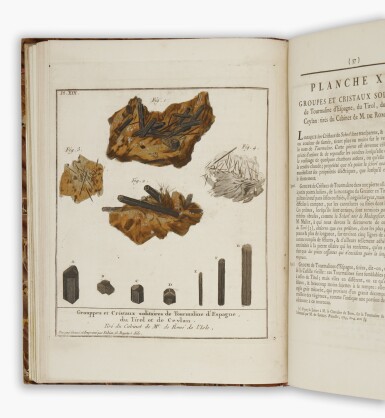
Gautier d'Agoty | First edition of Histoire Naturelle … Règne Minéral, Paris, 1781
Live auction begins on:
December 9, 08:00 PM GMT
Estimate
40,000 - 60,000 USD
Bid
32,000 USD
Lot Details
Description
Gautier d'Agoty, Jean-Fabien (& Jean-Baptiste-Louis Romé de l'Isle)
Histoire naturelle, ou exposition générale de toutes ses parties gravées et imprimées en couleurs naturelles, avec des notes historiques. Partie I. Règne Minéral [all published]. Paris: Imprimerie de Monsieur, sous la direction de P. Fr. Didot jeune,1781
4to (209 x 214 mm). 60 (of 70?; see below) engraved plates printed in colors and finished by hand in colors and silver and gold after d'Agoty (1–30) and Desfontaines (31–60), accompanied by letterpress descriptions; some scattered foxing, mostly affecting text leaves. Nineteenth-century tree calf over marbled boards, smooth spine gilt in six compartments, second with a red morocco title label, plain endpapers, yellow edges; extremities rubbed.
First edition of Gautier d’Agoty’s extraordinary production, certainly the most famous example of color printing in the service of mineralogy. J. B. L. Romé de l'Isle, the author of Essai de Cristallographie (Paris, 1772 and 1783), prepared the text and the specimens are in part drawn from his well-known collection. Firmin Didot supervised the letterpress printing and the plates are color printed by Gautier D'Agoty, and finished by hand, sometimes with the addition of metallic inks or gouaches. The publisher, the "Monsieur" in the imprint, has been identified by Wilson as French nobility, Louis Xavier Stanislas, Count of Provence, later King Louis XVIII.
D'Agoty approached the famous Romé de l'Isle with the outlines of a book illustrating mineral specimens, which was planned as one part of a trio of volumes illustrating the three kingdoms of natural history (the volumes on animals and plants never appeared). There were to be one hundred color plates, published in parts of ten plates each. Romé de l'Isle was to furnish the text and many of the specimens. Unfortunately, Gautier D'Agoty died late in 1781 after finishing only thirty plates. His widow and Rome de l'Isle assumed the responsibility for the book and another thirty plates were completed by the artist François Desfontaines, before Romé de l'Isle died in 1790. The color plates depict many of the finest specimens in Paris, no less than sixty-eight of Romé de l'Isle own specimens were used with others coming from the major Parisian collectors such as Sage, Bertin, Forster, Joubert, d'Orcy and others. An additional fascicle of ten plates (1792), believed to be unique, was discovered in the British Museum library among the collection of Desfontaines, including many drawings he made for the project. It is unclear if this final "Decade" was officially published.
“Very rare. This book is one of the finest colored mineralogies ever published. … Many references to the first four installments appear in the second edition of Romé de l'Isle's Cristallographie (4 vols., Paris, 1783). But after those mentions the publishing history is obscure. The fact that the majority of copies of this book contain forty or less plates indicate the publication lapsed for some time after the fourth decade was issued. Only a few copies are known to contain plates 50–60, and only the British Library Catalog lists a copy with seventy plates, although no description text accompanies plates 61–70. The lack of descriptions with the plates may indicate that the final installment was prepared after Romé de l'Isle's death in 1790. One last tantilizing clue appeared in the "Avertissement" to Desfontaine's Manuel Cristallographie (Paris, 1792). There he explains that he will complete a work begun by Romé de l'Isle and of which seven decades had already appeared. This is undoubtedly a reference to d'Agoty's work, but alas Desfontaine's claim was never fulfilled, and the last hope for continuing Fabien's remarkable book evaporated” (Schuh, Annotated Bio-Bibliography of Mineralogy and Crystallography 1469–1919).
REFERENCES
“Fabien Gautier D'Agoty and his Histoire Naturelle Règne Minéral,” in Wilson, Mineral Books, pp. 65–76; Wilson, Mineral Collecting, pp. 52–53
You May Also Like


![Darwin and Wallace | On the Tendency of Species to form Varieties... , [contained in:] Journal of the Proceedings of the Linnean Society, Vol. III, No. 9., 1858, Darwin announces the theory of natural selection](https://dam.sothebys.com/dam/image/lot/30891576-117d-4943-b2fa-a8ad164ee5f7/primary/extra_small)


