
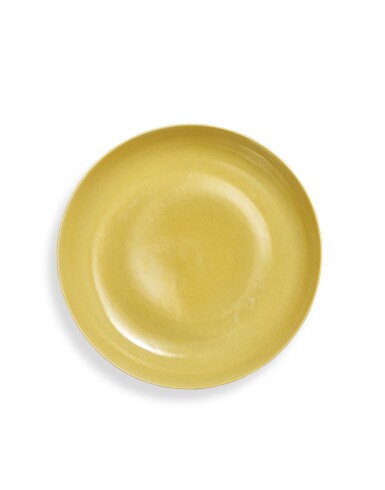
A yellow-glazed dish, Mark and period of Hongzhi | 明弘治 黃釉盤 《大明弘治年製》款
Estimate
300,000 - 600,000 HKD
Lot Details
Description
with shallow rounded sides resting on a tapered foot, applied overall with an even pale yellow glaze, the base left white and inscribed with a six-character reign mark in underglaze blue within a double circle
21.5 cm
John Sparks Ltd, London, 1980.
Deceptively simple in form and colour, the production of monochrome porcelain such as the present imperial yellow dish demands the highest level of skill and utmost precision, from the purity of the clay and the potting to the firing and glazing, which entails the application of a low-fired yellow lead glaze onto high-fired white-glazed porcelain. The slightest imperfection would result in the rejection and destruction of the piece. Aptly termed 'imperial yellow', this glaze had always been reserved for imperial court use since the introduction of yellow monochrome porcelain at the beginning of the Ming dynasty, though on rare occasions, yellow-glazed wares were also presented as diplomatic gifts to political and religious leaders beyond China.
The present dish is notable for its smooth, even, and softly lustrous yellow glaze, characteristic of imperial yellow wares of the Hongzhi reign (r. 1487-1505). This aesthetically pleasing shade was ingeniously achieved by slightly increasing the amount of iron oxide in the glaze solution. So admired was this hue that even the Kangxi Emperor (r. 1662-1722) of the succeeding dynasty attempted to replicate it.
A closely related dish from the Qing Court collection and still in Beijing is illustrated in The Complete Collection of Treasures of the Palace Museum. Monochrome Porcelain, Hong Kong, 1999, pl. 3; another in the Taipei Palace Museum is published in Minji meihin zuroku [Illustrated catalogue of important Ming porcelains], vol. 2, Tokyo, 1977, pl. 78; and another in the Musée Guimet, Paris, inv. no. MA4910. One of the very rare examples of imperial Chinese dishes of this type to have reached the Near or Middle East is illustrated in Regina Krahl, Chinese Ceramics in the Topkapi Saray Museum, Istanbul, London, 1986, vol. 2, pl. 774, and again in colour, p. 447. Compare also one from the Leshantang Collection, sold in these rooms, 9th April 2024, lot 126; and another, formerly from the Edward T. Hall and Ise Collections, also sold in these rooms, 2nd May 2000, lot 503, and again, 9th September 2025, lot 5048.
來源
John Sparks Ltd,倫敦,1980年
黃釉創燒於明初景德鎮御窰,昔為皇家御用之色,管制嚴格,僅寥若晨星之例用於外事,以禮待友邦之君。單色釉器燒造技巧要求極高,須取純土,施精工,胎、釉、火皆須嫻熟,佳器方成。亦因形簡色單,如有微瑕,必致毀棄。此盤釉色溫潤滑膩,勻淨淡雅,實為明代黃釉器之佳作,後朝康熙帝亦心慕手追此釉色,遷工匠復燒。
北京故宮博物院藏一例,為清宮舊藏,收錄於《故宮博物院藏文物珍品全集.顏色釉》,香港,1999年,圖版3。台北故宮博物院亦藏一例,載於《明瓷名品圖錄》,卷2,東京,1977年,圖版78。巴黎吉美國立亞洲藝術博物館復見一例,館藏編號 MA4910。相類之作亦遠播西亞,圖見康蕊君,《Chinese Ceramics in the Topkapi Saray Museum, Istanbul》,卷2,倫敦,1986年,圖版774及頁447。私人收藏見數例可資參考,如樂山堂舊藏一例,釋於香港蘇富比2024年4月9日,編號126;另一盤經霍爾及伊勢彥信遞藏,先後售於香港蘇富比2000年5月2日,編號503,及2025年9月9日,編號5048。
You May Also Like


