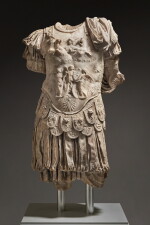
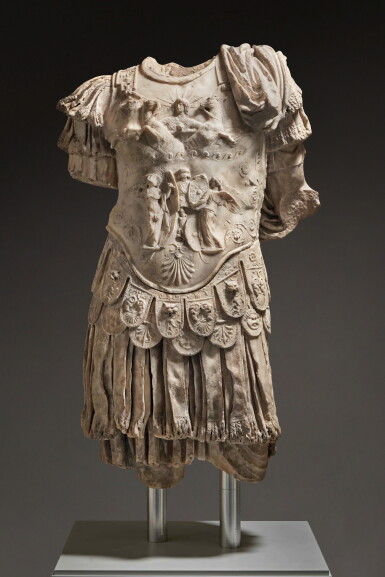
A Marble Torso of an Emperor, Roman Imperial, Julio-Claudian, 1st half of the 1st century A.D.
Premium Lot
Estimate
8,000,000 - 12,000,000 USD
Premium Lot
Lot Details
Description
A Marble Torso of an Emperor, Roman Imperial, Julio-Claudian, 1st half of the 1st century A.D.
probably representing one of the Julio-Claudian emperors, carved in two parts, standing with the weight on his right leg and wearing a tunic, leather corselet with fringed lappets falling at the waist and shoulders, bronze cuirass, and paludamentum falling from the left shoulder over the back and formerly over the extended left forearm, the bronze breastplate decorated in relief on the chest with the god Sol emerging from the waters in a frontal quadriga and on the abdomen with two Victories flanking a trophy and hanging shields onto it, a large inverted palmette below with scrolling acanthus and rosettes on either side, the upper row of pteryges decorated with alternating feline heads above lotus flowers and addorsed rams' heads above palmettes, the lower row with alternating gorgoneia and palmettes, a bearded head interrupting the sequence on the right hip, the neck carved out for insertion of a portrait head.
marble
height 43 ¼ in.
110 cm
said to be from Salona in Dalmatia, probably from one of the twin temples on the northeast corner of the forum;
Aloys Maximilian Neumann (1829-1906), Graz, acquired in the mid 19th Century in Split, Kingdom of Dalmatia;
Thence by descent, Private Collection, Austria (Sotheby's, New York, June 11th, 2010, lot 37, illus.);
Where acquired by the present collector.
New York, The Metropolitan Museum of Art, March 2011 to August 2013;
New Haven, Conn., Yale University Art Gallery, August 2013 to February 2015;
New York, The Metropolitan Museum of Art, February 2015 to February 2017;
Los Angeles, The J.Paul Getty Museum, August 2021 to August 2024.
W. Schmid, "Torso einer Kaiserstatue im Panzer," in M. Abramić & V. Hoffiller, eds., Strena Buliciana: Commentationes gratulatoriae Francisco Bulic ob XV vitae lustra feliciter peracta oblatae a discipulis et amicis, Zagreb, 1924, pp. 45 ff., pl. 5;
J. Sieveking, Eine römische Panzerstatue in der Münchner Glyptothek (Winckelmannsprogramm der archäologischen Gesellschaft zu Berlin, 91), Berlin and Leipzig, 1931, pp. 10 and 20;
Festschrift fur Rudolf Egger: Beiträge zur älteren europäische Kulturgeschichte, Klagenfurt, 1954, p. 36;
K. Schauenburg, Helios, Berlin, 1955, p. 38, note 338;
J. W. Salomonson, Chair, Sceptre and Wreath: Historical Aspects of their Representations on Roman Sepulchral Monuments, Amsterdam, 1956, p. 45, note 77
C. C. Vermeule, "Hellenistic and Roman Cuirassed Statues," Berytus, vol. 13, 1959-1960, p. 39, no. 45;
B. Gabričević, "Antički spomenici otoka Visa," Prilozi povijesti umjetnosti u Dalmaciji, vol. 17, 1968, pp. 57-58;
Jahrbuch des Römisch-Germanischen Zentralmuseums Mainz, vol. 17, 1970, p. 144;
K. Stemmer, Untersuchungen zur Typologie, Chronologie und Ikonographie der Panzerstatuen, Berlin, 1978, pp. 56-57, cat. V 1, pl. 34,1, and pages 70-71, 126, 156, and 158;
C. C. Vermeule, Hellenistic and Roman Cuirassed Statues, Boston, 1980, p. 32, no. 21, illus. p. 60;
U. Kreilinger, Römische Bronzeappliken: Historisches reliefs im Kleinformat, Heidelberg, 1996, p. 39;
S. Ivčević, "Carske statue s Visa," Histria Antiqua, vol. 4, 1998, p. 77;
N. Cambi, Kiparstvo rimske Dalmacije, Split, 2005, p. 49, fig. 62;
J. Jeličić-Radonić, "Tragovi carskoga kulta u Saloni," Signa et Litterae (Znakovi I riječi) II, Split, 2008, pp. 84-85, fig. 2;
A. Prückler, 'Millionen-Schatz aus Graz erobert New York', Kleine Zeitung, June 11 2010;
S. Melikian, 'When Roman statues play pranks', The New York Times, June 19 2010, p. 20, illus p. 1;
Arachne. Datenbank und kulturelle Archive des Forschungsarchiv für Antike Plastik Köln und des Deutsches Archäologisches Instituts, no. 32209.
You May Also Like