Giovanni Domenico Tiepolo
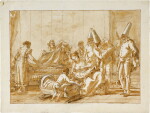
Punchinello is Viewed by Mourners
Estimate
400,000 - 600,000 USD
Lot Details
Description
Giovanni Domenico Tiepolo
Venice 1727 - 1804
Punchinello is Viewed by Mourners
pen and brown ink and two shades of brown wash, over black chalk, within brown ink framing lines;
numbered in brown ink, upper left: 101
13 ¾ by 18 ⅜ in.
350 by 465 mm
Anonymous sale, London, Sotheby's, 6-7 July 1920, part of lot 41, (purchased by Colnaghi for £610);
With P. & D. Colnaghi, London (purchased by Richard Owen for £800);
Richard Owen, Paris, by 1921;
Léon Suzor, Paris;
Anonymous sale, Paris, Hôtel Drouot, 16 March 1966, lot 65;
European private collection;
With Artemis Associated S.A., by 2017;
Where acquired by the present collector.
Paris, Musée des Arts Décoratifs, Dessins de G.D. Tiepolo, 1921.
A. Gealt and M.E. Vetrocq, Domenico Tiepolo's Punchinello Drawings, exhib. cat., Bloomington, Indiana University Art Museum, et al., 1979, S23;
G. Knox, "Domenico Tiepolo's Punchinello Drawings, Satire, or Labor of Love?," Satire in the Eighteenth Century, New York/London 1983, p. 146;
A. Gealt, Domenico Tiepolo: The Punchinello Drawings, New York 1986, p. 193, no. 104, reproduced;
M. Agazzi and G. Zavatta, Giandomenico Tiepolo's "Divertimento per li regazzi." The recovered albums of the Antonio Morassi Photo Archive, Venice 2025, p. 62 and p. 187, no. 104, pl. 99, reproduced.
The immensely lively and varied series of drawings illustrating scenes from the life (and death) of Punchinello, the famous character from the Commedia dell'Arte, are among the most celebrated and desirable of all Giandomenico's works. Punchinello is Viewed by Mourners is one of 104 episodes depicted in this endlessly inventive series of drawings, which, though never bound, remained together and complete, with a titlepage inscribed Divertimenti per i Ragazzi, from the late 18th century until they were dispersed by Richard Owen in 1921 (see Provenance and Exhibited). Through the detailed studies of James Byam Shaw and, more recently, Adelheid Gealt (see Literature), we have become familiar with the adventures of the series' mischievous protagonist, Punchinello, who became a beloved popular hero in Naples when he was introduced onto the stage by the actor Silvio Fiorillo at the beginning of the 17th century. By the 18th century, the improvised adventures of this tragi-comic figure were becoming enormously popular across Europe.
The narrative created by Giandomenico does not appear to be based on any known text; the stories were most probably handed down orally, in accordance with the traditions of popular theatre. The intended sequence of the drawings is also difficult to establish because the numbers which appear, as here, on most of the sheets, were added after Giandomenico's death, possibly, as Byam Shaw suggests, by his executor. A recent publication (see Literature) supported by Save Venice has allowed two photographic albums from Antonio Morassi’s photo archive to be reproduced, documenting for the first time since their dispersal by Richard Owen in 1921 the series’ oldest known order. The drawings develop further the themes treated in the delightful grisaille frescoes of the Camera dei Pagliacci, in the Tiepolo family villa at Zianigo (1793-97) where Giandomenico spent the final years of his life.1 It was at this late stage in his career that he turned his attention to making several extensive suites of large, finished drawings. The Scenes of Contemporary Life, similar in size and technique to the Punchinello drawings, are in many cases - and unusually for Giandomenico's drawings - dated. They were mostly executed in 1791, although some must have been done later, at more or less the same time as the Large Biblical Series, which can be dated towards the end of that decade. The Punchinello series is the last of all and in many ways the most ambitious, with its extremely diverse narrative, ranging from intimate family scenes to exotic adventures. Byam Shaw suggested that the drawings can be grouped under five broad chapter headings: The Ancestry, Childhood and Youthful Amusements of Punchinello; His Various Trades and Occupations; His Adventures in Strange Countries; His Social and Official Life; His Last Illness and Death.2
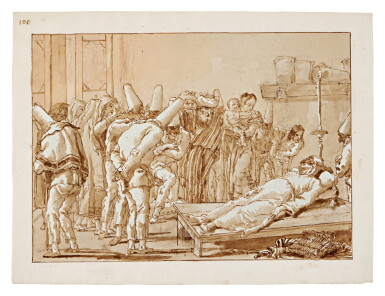
In the present composition, characteristically drawn and washed in two shades of brown ink, Punchinello, much to the sorrow of his companions, who stand with their heads bowed, is laid out, lifeless, on a wooden palette. “A candle burns above him, pointing to the shelved gnocchi pots which once gave him so much pleasure. Mourners from all walks of life, including orientals who populate so many episodes in the series, exhibit equal measures of grief and curiosity as they pay their last respects to a dear dead friend.”3 Another drawing, now in the Morgan Library & Museum, New York, depicts a similar scene of Punchinello’s death, as he lies motionless on his bed with doctors and other attendants surrounding him.4
As Byam Shaw observed, in the drawings from this series Giandomenico seems to go back more than ever before to earlier inventions, and to borrow more frequently from previous compositions, both from his own, especially the Contemporary Life scenes, and from those of his father. Indeed, it is in Giovanni Battista Tiepolo's drawings and etchings from the middle of the 1730s that Punchinello appears first,5 for instance in Punchinello talking to two magicians (circa 1735),6 from the Scherzi di Fantasia, and thereafter he is to be found with some regularity in the work of both father and son. Despite being such late works, Giandomenico's Punchinello drawings from the great series to which the present sheet belongs are, however, still rendered with exquisite liveliness and always pervaded by a sense of amusement and a light-hearted spirit appropriate to the character of the 'hero' and his adventures. The Punchinello drawings, together with the scenes of Contemporary Life, can be considered the greatest contributions that Giandomenico made to Venetian art and will always be emblematic of his wit and fantasy in capturing a moment, and telling a story.
1. The frescoes of the Villa have been detached and are now in the Museum of Ca' Rezzonico in Venice.
2. J. Byam Shaw, op. cit., p. 56
3. A. Gealt, op. cit., p. 193
4. New York, The Morgan Library & Museum, inv. no. 2017.258
5. For more information on the Punchinello drawings by Giambattista see G. Knox, 'The Punchinello Drawings of Giambattista Tiepolo', Interpretazioni Veneziane, Studi di Storia dell'arte in onore di Michelangelo Muraro, Venice 1984, pp. 439-446
6. A. Rizzi, L'Opera grafica dei Tiepolo, Le acqueforti, Milan 1971, p. 50, no. 12, reproduced p. 51
You May Also Like